Select a site alphabetically from the choices shown in the box below. Alternatively, browse sculptural examples using the Forward/Back buttons.
Chapters for this volume, along with copies of original in-text images, are available here.


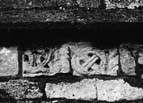
Object type: Part of grave-cover [1]
Measurements: L. c. 40 cm (15.7 in) W. c. 15 cm (5.9 in) D. Built in
Stone type: [Inaccessible but evidently Ancaster Freestone, Upper Lincolnshire Limestone, Inferior Oolite Group]
Plate numbers in printed volume: Fig. 9; Ill. 219
Corpus volume reference: Vol 5 p. 191
(There may be more views or larger images available for this item. Click on the thumbnail image to view.)
The stone has a line of pointing across its surface between the two panels as though it were in two sections. Careful inspection suggests that it is not.
B (long): A rectangular fragment decorated with cable moulding and interlace in low relief. No frame has survived along the top or bottom of the stone, although a single cable decorates its southern border. Within the stone, two panels are divided by a vertical double cable moulding. This creates a smaller square panel (at the southern end) and a longer horizontal panel to its north. The smaller square panel is occupied by a unit of interlace (motif ii, Fig. 10) with an incised medial line. The larger horizontal panel has a run of interlace which starts with a simple pattern E terminal and then continues beyond the stone with what could be a pattern F loop.
Davies (1926, 14) thought that this was two stones side by side, but re-inspection confirms that it is in fact a single stone which has been pointed down the junction between the two panels. The layout and style of the interlace, as well as the stone type, and the motif used, suggest that it is part of a grave-cover of mid-Kesteven type (Chapter V). The visible face represents one end of the flank of such a grave-cover, as reconstructed in Fig. 9. The fragment should be dated along with the group as a whole to the period between the mid tenth and the early eleventh century.
