Select a site alphabetically from the choices shown in the box below. Alternatively, browse sculptural examples using the Forward/Back buttons.
Chapters for this volume, along with copies of original in-text images, are available here.


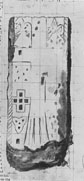
Object type: Grave-cover [1]
Measurements: Dimensions from Carter 1794, 500: L. 122 cm (48 in) W. 52 cm (20.5 in) D. 20.25 cm (8 in)
Stone type: Not recorded
Plate numbers in printed volume: Ill. 231
Corpus volume reference: Vol 5 p. 197-198
(There may be more views or larger images available for this item. Click on the thumbnail image to view.)
This was an almost complete flat rectangular or slightly tapering cover decorated in low relief on the top surface only, badly damaged through its secondary use. Description of its decoration relies entirely on a drawing by Ellen Carter, John Carter's wife, reproduced in the published engraving (Carter 1794, pl. I, fig. 2), which would be unintelligible or at best of very limited significance but for its very close similarity to the well-recorded grave-cover at Hackthorn (no. 1, Ills. 187–9).
A (top): The border is defined by a single cable moulding, much of it evidently removed through damage in reuse. The central field is filled with a square cross of type A1 that extends to the border. Its foot splays out perhaps originally to the full width of the field and contains what was clearly a decorative area the same as that of Hackthorn 1 and similarly based on a pair of triangular panels in relief outlined by an incised border. The cross is shown only as an incised feature, without Hackthorn's outline of cable moulding. Above the cross-arms, motifs only sketchily portrayed fill the available space. They could be understood as stylised birds, facing inwards, identical to those at Hackthorn, whose heads have been lost through the removal in reuse of the head end of the stone, leaving their pointed necks as the distinctive features shown. Below the cross-arm, decoration survives only on the left-hand side, and comprises three separate motifs. Only the lower two are clearly shown, as a triquetra (below) and a simple square interlaced pattern in a cross form, exactly as at Hackthorn except for the orientation of the triquetra. A more complex pattern immediately below the arm, depicted only as an irregular group of interstices, must have been some form of closed-circuit or related pattern (Cramp 1991, figs. 24 and 25), and forms the equivalent of the return-loop patterns in the same position at Hackthorn. Presumably matching identical motifs originally lay beneath the other cross-arm.
The drawing seems to show two or three rectangular holes in the surface, confirmed by reference to 'two holes, in which irons have been fixed' (Carter 1794, 500). Two holes close to the edge of the stone could be cramp holes, whilst a third and largest hole in the centre of the stone is in a sensible position for a Lewis hole and the right shape. The latter may indicate that the stone was a reused piece of Roman masonry, like Lincoln Cathedral 2. Despite the damage to it, the cover was reckoned to have been 'originally...highly finished' (ibid.) .
B and D (long): Undecorated, damaged in secondary use.
C (end): Head end deliberately removed in secondary use.
E (end): Foot end broken.
F (bottom): No information.
For assessment of the sub-Borre style and affinities of the decoration, see Hackthorn 1 (Ills. 187–9). The probability that this cover is virtually identical decoratively and very similar dimensionally with that at Hackthorn gives it a two-fold importance. It stands with Hackthorn 1 at the head of a category or decorative tradition of grave-covers in the area that are based on a large central cross of type A1 surrounded with a variety of motifs (see discussion in Chapter V). Secondly and more importantly, it shows that a distinctive and complex design on a monument of high quality could be produced at least twice over. This argues perhaps a more organised production industry than might have been anticipated. That production seems likely to have been Lincoln-based, on the evidence of the stone type of Hackthorn 1, the location of the pieces, and the likely source of so markedly Scandinavian artistic inspiration, when it is generally conspicuously lacking in the material from the rest of the county (see Chapter VIII and Fig. 22).
