Select a site alphabetically from the choices shown in the box below. Alternatively, browse sculptural examples using the Forward/Back buttons.
Chapters for this volume, along with copies of original in-text images, are available here.


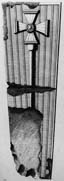
Object type: Grave-cover
Measurements: H. c. 201 cm (79 in) W. c. 68.5 cm (27 in) D. Not recorded
Stone type: Not recorded
Plate numbers in printed volume: Ill. 404
Corpus volume reference: Vol 5 p. 281
(There may be more views or larger images available for this item. Click on the thumbnail image to view.)
Gough's published drawing shows a tapered cover, decorated on its upper surface only. The decoration is confined to a long-stemmed cross with four wedge-shaped arms (type B6). The arms are elaborated with narrow bands or fillets and the centre is circular, with a complex centre-piece perhaps representing a raised and facetted boss. The narrow stem is linked to the cross-head by a collar or knop: it evidently ran the length of the cover but the form of its base is not known because it had been removed by surface damage.
Appendix A item (stones dating from Saxo-Norman overlap period or of uncertain date).
This cover is included here because monuments employing a similar long-stemmed type B6 cross as their sole decoration have been assessed as pre-Conquest, e.g. Hexham 14 and 16 (Cramp 1984, 182–3, pls. 179, 954 and 181, 970). The flat Viking-period cover from Cross Canonby (no. 4: Bailey and Cramp 1988, 89, ills. 222–3) has the same long-stemmed cross form though without the lower cross-arm and with the stem cabled; the centre of its cross-head is elaborated with an incised circle. At Peterborough and in the Cambridge region, however, coped covers with well-marked longitudinal ribs in relief, wedge-shaped cross-arms and no in-filling interlace have been taken by Fox (1920–1, 35–6) to mark a transition from eleventh-century interlaced covers to thirteenth-century coped types. This Lincoln Cathedral cover also extends the range of local pieces employing this decorative type, that includes the pair of covers from Langton by Wragby (Ills. 228–9), Lincoln St Mark 20 (Ill. 411), the ?tympanum from Nettleton (no. 1, Ill. 418) and the tympanum from Rowston (no. 3, Ill. 493), and Marton 5 (Ill. 300). The latter provides the most secure archaeological context for the motif through its reuse in a late eleventh-century tower. But a similar cross including banded arms occurs, for example, on the finely elaborated Romanesque tympanum at Hawksworth, Nottinghamshire (Keyser 1927, fig. 94).
By comparison, Lincoln Cathedral 3 was clearly a finely finished cover and its decoration may have been a skeuomorphic representation of a processional cross. The elaborated central boss can be compared with the roundels on the tympanum at Bishop Norton with their secure art-historical context of c. 1150 (Binnall 1961). From Gough's description of the discovery, it seems likely that this was a burial in the Norman north transept sealed by the reflooring accompanying St Hugh's elaboration of the cathedral's east end, and therefore pre-1180.
