Select a site alphabetically from the choices shown in the box below. Alternatively, browse sculptural examples using the Forward/Back buttons.
Chapters for this volume, along with copies of original in-text images, are available here.


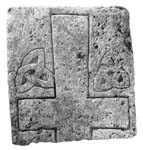
Object type: Incomplete grave-cover, in two non-adjacent pieces
Measurements:
a: L. 67 cm (26.5 in) W. 60 cm (23.5 in) D. 17 cm (6.75 in)
b: L.69 cm (27 in) W. 57.5 > 53 cm (22.5 > 20.75 in) D. 17 cm (6.75 in)
Stone type: Pale grey, orange-brown streaked, even-grained oolitic limestone with 'millet-seed' ooliths of 0.5 to 0.7mm diameter in a finely granular matrix (0.1 to 0.2mm grains). Some thin but fairly large (1 to 3cm) shell fragments, parallel to the bedding. A little interstitial calcite cement, and one very thin calcite vein, perpendicular to the bedding. Lower Lincolnshire Limestone, probably from Lincoln vicinity
Plate numbers in printed volume: Ills. 243–4
Corpus volume reference: Vol 5 p. 202-203
(There may be more views or larger images available for this item. Click on the thumbnail image to view.)
Two non-joining pieces from the upper and lower ends of the same flat, slightly tapering cover, of which a middle section of unknown size does not survive. Decoration is confined to the upper surface and is incised.
A (top): Stone 6a. There is no border. Decoration is limited to a plain cross with rectangular arms of type A1 that do not extend to the cover's edge but leave space as if for a border. In the upper left and right fields are triquetras (Cramp 1991, fig. 25 Bi), that on the left badly laid out and executed as if the carver had set out to do a closed-circuit pattern with four points (as Cramp 1991, fig. 24B, or St Mark 8, Ill. 248) and been forced to amend it. Below the cross-arm the points of a further pair of incised knots survive, truncated by the stone having been split for secondary use.
Stone 6b. The cross stem splays out towards the lower corners of the cover and carries a reserved pattern of two elongated mirror-image triangles that produce a tridentine or tripartite foot.
B and D (long) and C (end): Undecorated.
E (end): Broken.
F (bottom): Original roughly dressed surface.
This is a much simplified and derived version of the covers from Hackthorn and Lincoln City (Broadgate) (Ills. 187–9, 231). It maintains a similarly proportioned cross form including its rather elongated upper arm but fails to fill the resulting fields with motifs of suitable shape. The lost motifs below the cross-arms might in theory have been any of a range of closed-circuit patterns, but the restrained simplicity of the whole cover in comparison with Hackthorn 1 and Lincoln City (Broadgate) 1, and the exact fit of the triquetra make further knots of that form a reasonable supposition (as Stocker 1986a, fig. 46). The use of the triquetra as a prime decorative motif is found on hogback grave-covers at Brompton, Yorkshire NR (Lang 1984, 121), and Plumbland, Cumberland (Bailey and Cramp 1988, ill. 535), on Yorkshire shafts such as those at Hawsker (Collingwood 1927, fig. 168) and Lastingham (Lang 1991, ills. 574–7), and in tenth-century metalwork such as the engraved silver casket plate (Wilson 1964, no. 154, 214–5, pl. XLIV) or the pendant (ibid., no. 149, 207–8, pl. XLIII), both in the British Museum.
