Select a site alphabetically from the choices shown in the box below. Alternatively, browse sculptural examples using the Forward/Back buttons.
Chapters for this volume, along with copies of original in-text images, are available here.


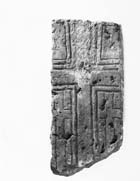
Object type: Incomplete grave-cover
Measurements: L. 123 cm (48.5 in) W. 56 cm (22 in) D. 21 cm (8.25 in)
Stone type: Pale yellow-brown oolitic limestone, with ooliths and pellets from 0.5 to 0.9mm diameter in a finely granular (0.1 to 0.2mm diameter granules) matrix, which includes some quartz silt. Bottom half of slab (away from carved surface) is less oolitic and siltier, and could be described as a calcareous siltstone or fine sandstone; as Lincoln St Mark 5. Greetwell Member, Lower Lincolnshire Limestone of Lincoln vicinity
Plate numbers in printed volume: Ill. 249
Corpus volume reference: Vol 5 p. 203
(There may be more views or larger images available for this item. Click on the thumbnail image to view.)
The greater part of a flat rectangular grave-cover with incised decoration on its upper surface only. The stone was slightly damaged in secondary use at the head end and trimmed along one complete side. Intact original surface on the other side shows the edges to have been slightly battered.
A (top): The design consists of a rectangular cross of type A1 marked out by a double incised channel of U section. In the three surviving directions the cross-arms extend to the cover's edge. Above the cross-arms on both sides an uncarved panel is reserved on three sides by an incised line. Below the cross-arms are two smaller rectangular crosses, also sharply incised. The feet of all three crosses are missing.
With its simple incised decorative scheme based on type A1 crosses, this cover is typical of the Lincoln products represented at St Mark's. In design and execution it is closely linked with St Mark 11 and 17 (Ills. 250, 256): though their petrology appears not to be identical, it is probably local to Lincoln. The iconography of three crosses, two flanking and supporting the central dominant one, referring to Calvary and the redemptive power of the Crucifixion, is unusually explicitly Christian among the later pre-Conquest sculpture of the county. As Stocker (1986a, 60, citing Lionard 1961, 101–5) has noted, however, the theme is a long-lived one in Merovingian and insular sculpture, and is represented locally in the elaborate schemes of Hackthorn 1 and Lincoln City (Broadgate) 1, perhaps in the first half of the tenth century (Ills. 187–9, 231), and in the cover at Howell of the eleventh century (Ill. 220), and in later post-Conquest examples in the region (Butler 1964, 113). The later tenth- to eleventh-century date given by the St Mark's excavation fits well with the suggestion that the Hackthorn/Broadgate cover type may have influenced this as it did other products in the St Mark's collection.
