Select a site alphabetically from the choices shown in the box below. Alternatively, browse sculptural examples using the Forward/Back buttons.
Chapters for this volume, along with copies of original in-text images, are available here.


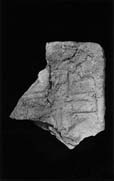
Object type: Part of grave-cover, in three non-adjacent pieces
Measurements:
a: L.72 cm (28.25 in) W. 68 > 66 cm (26.75 > 26 in) D. 17 cm (6.5 in)
b: L. 33 cm (13 in) W. 23 cm (9 in) D. 17 cm (6.5 in)
c: L. 32 cm (12.5 in) W. 48 cm (19 in)
D. 17 cm (6.5 in)
Stone type: Yellow-brown, laminated fine-grained calcareous sandstone (0.1 to 0.2mm quartz grains), similar to Lincoln St Mark 9 but more arenaceous; scattered 0.5mm cavities where ooliths or small pellets have dropped out; similar to St Mark 5. Greetwell Member, Lower Lincolnshire Limestone of Lincoln vicinity.
Plate numbers in printed volume: Ills. 246–7
Corpus volume reference: Vol 5 p. 205
(There may be more views or larger images available for this item. Click on the thumbnail image to view.)
Three non-conjoined fragments from the head end of a large, flat, tapered grave-cover. Decoration is confined to the upper surface and survives only on the largest stone (10a): the precise positioning of the other two fragments within the cover is therefore uncertain.
A (top): Traces of a plain border marked out by an incised line survive along the head end. Within an otherwise blank field, a cross with rectangular arms is outlined by a roughly incised line; and centrally placed within that is a recessed cross of type A1, more carefully cut and following the same outline.
B and D (long) and C (end): Original undecorated edges cut to a slight splay.
E (end): Broken in secondary use.
F (bottom): Original surface survives only along one side.
This grave-cover falls within the local group of covers and markers with decoration based on a rectangular cross-head. Its lack of further elaboration associates it with no. 9 in the St Mark's collection (Ill. 245), with examples such as Brauncewell 1, Carlby 1, and Castle Bytham 1 in the county (Ills. 65, 83, 88), and more widely afield with examples in the Cambridge Castle group (Fox 1920–1, nos. 1 and 4) and at York (Lang 1991, ill. 351). Its arrangement of a double outline cross with the inner element treated in some cases distinctively in texture or decoration it shares significantly with members of the group of markers local to Lincoln and Lindsey (see Chapter V), and especially with the marker at Glentworth with its 'feathered' or chevron inner cross (Ill. 179). Comparable designs are also found in the funerary sculpture of the Cambridge region, as with a marker with double outline cross at Peterborough (Fox 1920–1, pl. VII) and a grave-cover from Cambridge Castle (ibid., pl. III no. 3) on which the inner zones of its crosses are filled with interlace.
