Select a site alphabetically from the choices shown in the box below. Alternatively, browse sculptural examples using the Forward/Back buttons.
Chapters for this volume, along with copies of original in-text images, are available here.


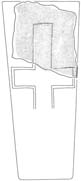
Object type: Part of grave-cover
Measurements: L. 61 cm (24 in) W. 55 cm (21.5 in) D. 12 cm (4.75 in)
Stone type: Yellow-brown fine-grained calcareous sandstone (0.1 to 0.2mm quartz grains) with scattered ooliths and fine shell fragments; some ooliths have dropped out, to leave hemispherical cavities of 0.6mm diameter; as Lincoln St Mark 5. Greetwell Member, Lower Lincolnshire Limestone of Lincoln vicinity, Inferior Oolite Group
Plate numbers in printed volume: Ill. 245
Corpus volume reference: Vol 5 p. 204
(There may be more views or larger images available for this item. Click on the thumbnail image to view.)
A fragment from towards the head end of a large flat grave-cover, decorated only on its upper surface. The angle between the small section of original edge and the lie of the cross suggests that the cover tapered. Decoration consists solely of the long upper arm and part of the cross member of a rectangular cross (type A1) delineated by crudely incised lines. There is no evidence for a border.
Like St Mark 10 (Ills. 246–7), which it resembles petrologically, this belongs to the local group of covers based on a rectangular cross-head. With its total absence of decorative elaboration or distinction, its analogies apparently lie with examples such as Brauncewell 1 (Ill. 65) and Carlby 1 (Ill. 83), but the proportions of its upper long cross-arm to its cross-member are so similar to the St Mark 6 cover (Ill. 243) that it could be a contemporary product simply lacking the additional decorative motifs.
