Select a site alphabetically from the choices shown in the box below. Alternatively, browse sculptural examples using the Forward/Back buttons.
Chapters for this volume, along with copies of original in-text images, are available here.


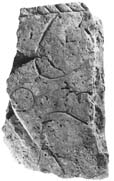
Object type: Incomplete grave-cover, in two non-adjacent pieces
Measurements:
a: L. 39 cm (15.5 in) W. 65 > 60 cm (25.5 > 23.5 in) D. 24 cm (9.5 in)
b: L. 96.5 cm (38 in) W. 57 > 46 cm (22.5 > 18 in) D. 24 cm (9.5 in)
Stone type: Pale brown fine-grained sandstone with scattered ooliths. The top surface of the slab (as carved) is a 2cm layer of shelly coarse oolite; as Lincoln St Mark 5. Greetwell Member, Lower Lincolnshire Limestone of Lincoln vicinity
Plate numbers in printed volume: Ills. 253–4
Corpus volume reference: Vol 5 p. 206-207
(There may be more views or larger images available for this item. Click on the thumbnail image to view.)
Two non-joining pieces from the upper and lower ends of the same flat, tapering grave-cover, that together make up the greater part of a complete cover measuring close to 150 cm (59 in) in length. Decoration is confined to the upper surface and is incised.
A (top): Stone 13a. The border is of single cabled form. The incised decoration takes the form of a cross-head of type B10 with armpits of deep U form; there is a small incised circular boss in its centre, and the arms extend to the cabled border.
Stone 13b. A broad incised shaft with out-turned foot developing from the lower arm of the same cross-head of type B10 as on stone a. The border is also a moulded single cable.
B–F: Original undecorated sides, ends and bottom survive.
This cover lies outside the dominant local tradition of using a rectangular cross of type A1 as the basis of decoration. Its boldly cabled border nevertheless links it with the traditions of Lindsey slabs and markers (cf. Chapter V). The cross type is found on two small pre-Viking slabs from Wensley and a third from West Witton, both in the North Riding of Yorkshire (Collingwood 1927, fig. 17, b, c, f ), and in Cumbria too in pre-Viking contexts, both in the head of the free-standing cross at Irton, Cumberland (Bailey and Cramp 1988, 115–17, ills. 359, 361), and as incised or low relief decoration on covers at Knells (no. 1) and Isel (no. 3) (ibid., 119, 126, ills. 379, 425–6), in the latter instance with a cabled border and incised circular boss. Two markers (nos. 27 and 29) from the Minster excavations at York deploying the same incised crosshead type potentially provide a close analogy (Lang 1991, 68–70, ills. 111, 121). Minster 27 also has a similar incised boss. Their date has been assessed implausibly as late eighth to ninth century on stylistic grounds, despite their crudeness and the fact that the cross of no. 27 has a stepped base, normally a post-Conquest feature. Minster 27 has an archaeological terminus ante quem in its thirteenth-century reuse. The archaeological context of the St Mark's cover, however, is clearly mid tenth-century or later (Stocker 1986b, 93), so probably more relevant to its date is the occurrence of this and closely related cross types as the sole incised decoration on covers of late pre-Conquest if not post-Conquest date, as at Bewcastle 4 and 6, Cumberland (Bailey and Cramp 1988, 73–4, 162–3, ills. 127–8, 622–3), and Ardwall in south-west Scotland (Thomas 1967, fig. 30), or as a cross-head on Brigham 7, Cumberland, of tenth/eleventh-century date (Bailey and Cramp 1988, 77, ills. 152–3). Locally, the upper arm of the main cross on the eleventh-century cover at Howell (Ill. 220) is of a similar curving form, and the feet of the two subsidiary crosses are out-turned, as is the foot of the incised cross on the tapered cover Lincoln St Paul 2 (Ill. 277).
