Select a site alphabetically from the choices shown in the box below. Alternatively, browse sculptural examples using the Forward/Back buttons.
Chapters for this volume, along with copies of original in-text images, are available here.


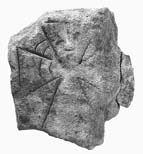
Object type: Part of grave-cover or -marker
Measurements: L. 25.5 cm (10 in) W. 20.5 cm (8 in) D. 12.5 cm (5 in)
Stone type: Pale to medium grey oolitic limestone, a grainstone composed of close-packed ooliths of 0.4 mm diameter; as Lincoln St Mark 1. Ancaster Freestone, Upper Lincolnshire Limestone, Inferior Oolite Group
Plate numbers in printed volume: Ill. 252
Corpus volume reference: Vol 5 p. 207
(There may be more views or larger images available for this item. Click on the thumbnail image to view.)
Part of the head end of a small, flat and perhaps rectangular grave-cover or -marker. Insufficient survives to judge certainly whether it was at all tapered. Decoration is confined to one surface and none is evident on the bottom/back where original dressed surface is intact. It comprises a crudely incised cross-head with wedge-shaped arms of type B6 that reached close to the edges of the stone. Between the upper and left-hand arm is an incised double curved line representing a ring of type a; on the upper and left-hand arms a similar double incision is set nearer the centre in such a way that the inner incision between the arms is one with the outer incision on the arms.
It is not possible to be certain whether this is a cover or a marker, but analogy with Lincoln St Mark 20, 21 and 22 (Ills. 405, 406, 411), as well as no. II/16 (Stocker 1986a, fig. 52) plus the large number of undecorated small covers from these excavations perhaps favours the former. The cross-head type finds its best archaeological context locally in Marton 5 (Ill. 300), apparently of eleventh-century date. The type and related variants is also found on Lincoln St Mark 20 (Ill. 411), Carlby 2 (Ill. 84), Castle Bytham 1 (Ill. 88), Langton by Wragby 1 and 2 (Ills. 228–9) and on the ?tympanum fragment at Nettleton (Ill. 418). At least the latter instance and the occurrence of the cross type on the large 'roofed' cover, Lincoln St Mark 26 (Ill. 413–15), show it still current in the twelfth century. Simply incised or low relief B6 crosses on markers and covers in York and the East Riding have been taken to be of eleventh-century date (Lang 1991, 68 (Minster 28), 108 (Parliament Street 3), 222 (Wharram Percy 2)).If there was an intention to indicate a ring head with incisions on Lincoln St Mark 20 (Ill. 411), the analogy with that piece would be particularly close. The presence of a ring-headed cross, however misconceived and ill-executed, should indicate a monument of the Anglo-Scandinavian period (Bailey 1980b, 70–1).
