Select a site alphabetically from the choices shown in the box below. Alternatively, browse sculptural examples using the Forward/Back buttons.
Chapters for this volume, along with copies of original in-text images, are available here.


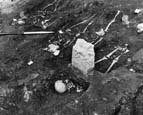
Object type: Lower part of grave-marker
Measurements: H. 54.5 cm (21.5 in) W. 31 > 23 cm (12.25 > 9 in) D. 12.25 cm (4.75 in)
Stone type: Pale brownish-yellow oolitic limestone, rather fine-grained (0.3mm ooliths), with scattered pellets, small (5mm) arcuate shell fragments, and spicule-like bodies; the stone has very little interstitial cement, and numerous small cavities; as Lincoln St Mark 1. Ancaster Freestone, Upper Lincolnshire Limestone, Inferior Oolite Group
Plate numbers in printed volume: Ills. 263–4
Corpus volume reference: Vol 5 p. 209-210
(There may be more views or larger images available for this item. Click on the thumbnail image to view.)
The lower part of an upright tapered grave-marker whose top has been roughly broken off as it stood in situ. It is decorated on both broad faces; the narrow faces are plain.
A (west, broad): Within a plain, narrow border defined by an incised line, the broad plain stem of a cross is flanked by symmetrical panels with Stafford knots (simple pattern E) in low relief. There is slight evidence for the junction of the left cross-arm with the stem, which with the panels suggests a rectangular cross of type A1. The linear incisions fade out against the lower rough-hewn section of the marker that was earthfast.
C (east, broad): The decoration seems to have started higher on the stone and survives only as the end of a plain border defined by an incised line and a short incised arc central to the face that could be accidental.
The principal importance of this piece lies in its archaeologically established context as an in situ funerary monument. There were three burials below the grave-marker, which might be taken to represent three generations. If the graveyard started c. 950 as suggested, then a date around or shortly after 1000 would be appropriate for the monument. A notable aspect is its strong taper, giving it a form similar to some of the small covers and distinctively different from the rest of the grave-markers. This may open the possibility of the stone having been reused, perhaps on the same spot, and transformed from cover to marker.
The decorative scheme of its west face falls clearly within local traditions best exemplified on grave-covers, whether it is understood as thorough infilling of panels around a rectangular cross as on the covers from Lincoln Cathedral 1 or Ewerby 1, for example (Ills. 230, 170), or as symmetrical single knots placed above or below cross-arms as on Lincoln St Mark 6 or 8 (Ills. 243, 248). Back-to-back runs of Stafford knots are part of the standard repertoire of South Kesteven cross-shafts, as at Colsterworth, Stoke Rochford etc. and they appear on the broad faces of the small wheel-head cross from St Mark's itself (no. 1, Ills. 235–7).
