Select a site alphabetically from the choices shown in the box below. Alternatively, browse sculptural examples using the Forward/Back buttons.
Chapters for this volume, along with copies of original in-text images, are available here.


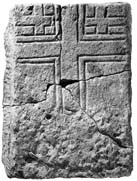
Object type: Grave-marker, in four pieces now joined
Measurements: H. 78.5 cm (31 in) W. 59 > 58 cm (23.25 > 22.75 in) D. 17 cm (6.75 in)
Stone type: Brownish-grey fine-grained calcareous sandstone or sandy limestone, with unevenly scattered ooliths, and small pellets of c. 0.6mm diameter, some in possible burrow-fills; as Lincoln St Mark 5. Greetwell Member, Lower Lincolnshire Limestone of Lincoln vicinity
Plate numbers in printed volume: Ill. 256
Corpus volume reference: Vol 5 p. 209
(There may be more views or larger images available for this item. Click on the thumbnail image to view.)
Four conjoining fragments that together make up a complete rectangular grave-marker with incised decoration on one broad face only.
A (broad): A rectangular cross of type A1 defined by a neatly executed double incised outline, though the alignment between upper and lower arms is not accurate. Its upper and lateral arms extend to the edges of the stone and the slightly longer lower arm or stem fades out against a zone occupying the lower third of the stone that has been left rough hewn and intended to be buried when the stone was in situ. Across the stem, immediately above the point of junction with this rough area, two lighter curving incisions are separate from the cross's double outline but may nevertheless be intended to give the impression of a pointed foot. In the upper left and right quadrants, small incised subsidiary crosses are distinctive in their poor alignment and in having their longest arms the outer lateral ones.
B and D (narrow): The sides are undecorated, B approximately square to the broad faces but D on a marked batter.
C (broad): Roughly dressed and undecorated and with casual damage from its secondary use at both top and bottom.
Except for its lack of a cable-moulded border, this marker has close affinities with the Lindsey group of markers (see Chapter V), and especially to those more finely produced examples at Gayton le Wold 1 (Ills. 180, 184), Glentworth 1 (Ill. 179) and Hackthorn 2 (Ills. 191, 193) on which the rectangular cross is defined by a close-spaced double incision amounting to a border, and the lateral arms reach to or almost to the border. As with several of that group, the rough-dressed lower part and slight bottom-heavy splay to the stone show a deliberate concern for the marker's earthfast stability. The most striking and important aspect of this piece, however, is its close decorative link with the grave-cover Lincoln St Mark 7 (Ill. 249), with its similar theme of the three crosses, and the consequent probability that the two were intended to go together en suite. This is the clearest case where this may be suggested, though Hackthorn 1 and 2 may be similarly associated; it may be that such en suite use was the norm for this type of marker.
The curving lines at the foot of the stem, if deliberately decorative, may be a skeuomorphic representation of a wooden marker.
The date range of the Lincoln/Lindsey group is defined on the one hand by its potential associations with the Lindsey type covers and in particular with the exceptional cover at Hackthorn, and on the other by the incorporation of the Glentworth example in the fabric of the presumably mid to late eleventh-century west tower there. In its context and link with St Mark 7 this piece fits comfortably in that date range.
