Select a site alphabetically from the choices shown in the box below. Alternatively, browse sculptural examples using the Forward/Back buttons.
Chapters for this volume, along with copies of original in-text images, are available here.


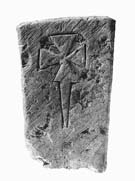
Object type: Part of grave-cover
Measurements: L. 48.5 cm (19 in); W. 31.5 > 24.5 cm (12.5 > 9.5 in); D. 16 cm (6.25 in)
Stone type: Pale grey to yellowish, finely granular limestone, with abundant Modiolus; cf. Lincoln St Paulin-the-Bail 1. Cathedral Beds, Lower Lincolnshire Limestone of Lincoln vicinity
Plate numbers in printed volume: Ill. 411
Corpus volume reference: Vol 5 p. 282-283
(There may be more views or larger images available for this item. Click on the thumbnail image to view.)
The complete upper end of a small, flat and tapered grave-cover, decorated on its upper surface only. The head end of the stone has been cut aslant and perhaps worked to a slightly domed form: the upper surface is dressed with clear diagonal tooling.
A (top): The face is edged with a rough chamfered border. Decoration is limited to a cross formy fitchée (a stemmed cross with wedge-shaped arms of type B6 or B8), partly in low relief and partly incised. Between the upper cross-arms, and especially on the left, curved incisions may not be casual damage but a partial representation of a ring head of type a (Cramp 1991, fig. 3), as on Lincoln (St Mark) 14.
B and D (long) and C (end): Undecorated original surfaces.
E (end) and F (bottom): Roughly broken.
Appendix A item (stones dating from Saxo-Norman overlap period or of uncertain date).
The evidence from the excavated collection of funerary monuments at St Mark's suggests that this type of cover might have a long potential date span of later tenth to mid thirteenth century (Stocker 1986a, 55–6). Its specific form – small, markedly tapered and with a tendency to a domed head end – may suggest a post-Conquest date. This stemmed cross form has been assessed as late pre-Conquest when encountered at Hexham, Northumberland, for example, decorating a grave-cover and a round-headed marker (Hexham 14 and 16: Cramp 1984, 182–3, pls. 179, 954 and 181, 970). At York, on markers from the Minster (no. 28) and Parliament Street (no. 3), stemmed crosses of B6 form without further elaboration are thought to be eleventh-century in date and compared with simple covers like Wharram Percy 2 (Lang 1991, 68, 108, 222, ills. 115, 357, 359, 883). Locally the best archaeological context for the cross-head type is Marton 5 (Ill. 300), apparently of eleventh-century date. The type and related variants is also found at Langton by Wragby 1 and 2 (Ills. 228–9), Carlby 2 (Ill. 84), Castle Bytham 1 (Ill. 88), Lincoln St Mark 14 (Ill. 252) and on the ?tympanum fragment at Nettleton (Ill. 418). At least the latter instance and the occurrence of the cross type on the large 'roofed' cover, Lincoln St Mark 26 (Ills. 413–14), which in feel and execution is very similar, show it still current in the twelfth century. If there was an intention to indicate a ring head, the analogy with Lincoln St Mark 14 would be particularly close and its date likely to be earlier rather than later. The pointed shape of the stem suggests a skeuomorphic representation of a wooden grave-marker, as perhaps on Lincoln St Mark 17 (Ill. 256).
