Select a site alphabetically from the choices shown in the box below. Alternatively, browse sculptural examples using the Forward/Back buttons.
Chapters for this volume, along with copies of original in-text images, are available here.


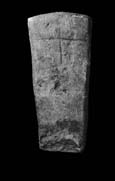
Object type: Grave-cover
Measurements: L. 54.5 cm (21.5 in) W. 26 > 18 cm (10.25 > 7 in) D. 14 cm (5.5 in)
Stone type: Pale grey finely granular limestone; under-surface of slab shows orange-brown pellets and numerous fossils including nerineid gastropods, Astarte and other bivalves. Reminiscent of Lincoln Cathedral stone. Cathedral Beds, Lower Lincolnshire Limestone of Lincoln vicinity
Plate numbers in printed volume: Ill. 405
Corpus volume reference: Vol 5 p. 283
(There may be more views or larger images available for this item. Click on the thumbnail image to view.)
A complete small tapered grave-cover with domed head, decorated on its upper surface only.
A (top): The face is edged with a slight chamfered border, and decorated only with a crude incised equal-armed cross (type A1).
Appendix A item (stones dating from Saxo-Norman overlap period or of uncertain date).
The evidence from the excavated collection of funerary monuments at St Mark's suggests that this type of cover might have a long potential date span of later tenth to mid thirteenth century (Stocker 1986a, 55–6). Its specific form – small, markedly tapered and with a domed head end – is very similar to St Mark 20 and may more clearly suggest a post-Conquest date, but the analogies for the simple decoration (as with Lincoln St Mark 22) are with the simplest monuments of presumed pre-Conquest date, as at Ardwall Isle, Kirkcudbright (Thomas 1967) and The Hirsel, Berwickshire (Cramp and Douglas-Home 1977–8). Hough-on-the-Hill 3 (Ill. 399), also a simply decorated stone, is built into a thirteenth-century wall in reuse.
