Select a site alphabetically from the choices shown in the box below. Alternatively, browse sculptural examples using the Forward/Back buttons.
Chapters for this volume, along with copies of original in-text images, are available here.


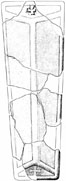
Object type: Part of grave-cover, in six pieces
Measurements: L. 182 cm (71.75 in) W. 63.5 > 45 cm (25 > 17.75 in) D. 27.5 cm (11 in)
Stone type: Brownish-grey limestone, with a slightly silty, finely granular matrix containing scattered ooliths and some shell fragments, including a nerineid gastropod; as Lincoln St Mark 5. Greetwell Member, Lower Lincolnshire Limestone of Lincoln vicinity
Plate numbers in printed volume: Ills. 413–15
Corpus volume reference: Vol 5 p. 285-286
(There may be more views or larger images available for this item. Click on the thumbnail image to view.)
Six conjoined fragments making up the greater part of a large tapered and coped grave-cover with roof-like hipped ends, decorated on its upper surface only.
A (top): The border, ridge rib and its Y-form development into the hipped gable ends are all defined by a bold roll moulding outlined by incised lines. In each gable there is a small cross with wedge-shaped arms (type B6 or B8) in low relief.
Appendix A item (stones dating from Saxo-Norman overlap period or of uncertain date).
This fine cover is included because of its use of a Corpus cross-head type and because of its close grouping with St Mark 25 and 27, the latter being a near identical but cruder copy of it. It stands in the tradition of roofed or house-like grave-covers, that was taken up in the Viking-age hogbacks (Bailey 1980b, 85–100; Lang 1984). In itself it has none of their distinctive characteristics, and rather finds its analogies in a mid twelfth-century monument in Purbeck marble in the crossing at Winchester Cathedral (Blore 1983, 11, pl. I), and covers at Ingleby Arncliffe and Lythe, Yorkshire NR (Schmidt 1973, 74–6, fig. 33), at the Temple church in London, in the south presbytery at Rochester Cathedral, and at Lanercost Priory. A similar architectural form underlies highly decorated pieces that still deploy pre-Conquest ornamental motifs, like the small cover from Bexhill, Sussex, thought eleventh-century by Kendrick (1949, 86, pl. LVI), though it is seen as slightly earlier by Tweddle (Tweddle et al. 1995, 122–3). Locally and outside the close analogies of nos. 25 and 27 at St Mark's, the only comparable (but grander) cover is the 'marble' monument from Rand, formerly said to be of fourteenth-century date (Butler 1964, 146) but more probably of the early thirteenth century (Pevsner and Harris 1964, 338–9; Stocker 1986a, 82, fn. 6). Kendrick (1949, 86) notes in west Sussex a group of flat crudely produced covers decorated only with ribs in the pattern of a coped hipped monument: he suggests a twelfth-century date for them, although they have more recently been dated to the eleventh century (Tweddle et al. 1995, 188–200). Like St Mark 25 and 27 this may confirm a wide-spread period currency of this form of monument. The cross form employed can be paralleled in common local use in the eleventh and twelfth centuries, with its securest archaeological context at Marton 5.
