Select a site alphabetically from the choices shown in the box below. Alternatively, browse sculptural examples using the Forward/Back buttons.
Chapters for this volume, along with copies of original in-text images, are available here.


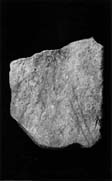
Object type: Part of grave-cover
Measurements: L. 71.5 cm (28.25 in) W. 58.5 > 57 cm (23 > 22.5 in) D. 20.5 cm (8 in)
Stone type: Pale yellow oolitic limestone, with ooliths of c. 0.5mm diameter fairly closely packed in a fine-grained matrix. Upper Lincolnshire Limestone
Plate numbers in printed volume: Ill. 407
Corpus volume reference: Vol 5 p. 285
(There may be more views or larger images available for this item. Click on the thumbnail image to view.)
A large fragment comprising the foot end of a large, flat, slightly tapered grave-cover, decorated on its upper surface only. The edges and foot end are vertical original dressed surfaces. The one undamaged corner has a vertical groove up its arris, that is apparently original.
A (top): Decoration is lightly incised and comprises pairs of parallel lines converging from the corners to a junction in the centre of the stone just where it is broken.
Appendix A item (stones dating from Saxo-Norman overlap period or of uncertain date).
The decoration seems likely to have run into a longitudinal rib and been replicated at the head end (as Stocker 1986a, fig. 60). It may represent an imitative rendering of the roof-like hipped pattern of Lincoln St Mark 26 and 27. The complementary grooving of the corners might tend to support this architectural context. Kendrick (1949, 86) also notes in west Sussex a group of flat crudely produced covers decorated only with ribs in the pattern of a coped hipped monument: he suggests a twelfth-century date for them and sees their derivation as the covers of the Cambridge area and especially such examples as the cover at Milton Bryan, Bedfordshire (ibid., 82, pl. LIV; cf. Tweddle et al. 1995, 188–200, 232). Certainly Fox's (1920–1) analysis sees the traditional forms stripped of their interlaced infilling as providing a transition to the new Barnack styles of the later twelfth and thirteenth centuries. Whether this piece falls in one tradition or the other, or perhaps links the two, is not clear. The Sussex examples may suggest a wide-spread period currency of this form of monument.
