Select a site alphabetically from the choices shown in the box below. Alternatively, browse sculptural examples using the Forward/Back buttons.
Chapters for this volume, along with copies of original in-text images, are available here.


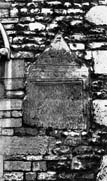
Object type: Architectural panel
Measurements: H. c.144 cm (56.75 in) W. c. 94 cm (37 in) D. Built in
Stone type: Yellowish grey (10YR 8/3) shelly oolite, with ooliths up to 0.6mm, but including fine-grained, micritic brownish patches and streaks, possibly burrow-fills. Among the shell fragments are bivalves or brachiopods, seen in cross-section. Cathedral Beds, Lower Lincolnshire Limestone of Lincoln vicinity, Inferior Oolite Group
Plate numbers in printed volume: Ills. 273–5
Corpus volume reference: Vol 5 p. 214-216
(There may be more views or larger images available for this item. Click on the thumbnail image to view.)
Reused Roman civilian gabled tombstone, broken roughly but approximately horizontally to form its lower edge. The break truncates the original Latin inscription, which otherwise survives in Roman capitals within a rectangular panel outlined by a simple double moulding (Hübner 1873, 53, no. 191; Richmond 1946, 49, fn. 159; Collingwood and Wright 1965, 87–8, no. 262). It reads:
DIS MANIBUS
NOMINI SACRI
BRUSCI FILI CIUIS
SENONI ET CARSSO
UNAE CONIUGIS
[EIUS ET QUINTI F–]
The upper part of the stone, comprising a steep pediment set between two terminals like antefixes in profile, has been trimmed off from immediately above the border of the Roman inscription to receive an Old English inscription in Anglo-Saxon capitals. This extends to five lines, set out between deeply incised horizontal guidelines (the lowest of which coincides with the upper outer edge of the Roman moulding) defining fields approximately 11 cm (4.25 in) deep. The letters are between 5 and 7 cm in height.
Inscription The following transcription is arranged as on the stone. The text reads upwards from the bottom to the top (lines 1 to 5).
5 [MAR]IE
4 [OFE7 S]CE
3 N[C]RISTET[O.]
2 –V[.F]I[O...T.]–
1 [+EIR]T[I]G[MELETǷ ]I[R.E]–
The inscription is in rather irregular Roman capitals. There are no very notable forms. The G in line 1 has an angled base. The O in line 4 is facetted, or at least not very round; it may be intended as a lozenge-shaped O, a form that can be seen for example on the sundial inscription of c. 1060 at Kirkdale (Lang 1991, 163). The inscription seems to have contained the Old English graph wynn and the Tironian sign for Old English and. On the basis of what is now legible the first line of the text can be edited as follows: [+] EI[R]TIG [M]E LET [Ƿ]I[R.E–]. The second line is not now readable. The clear V near the beginning of the line seems not to fit the AN at the start of the line in the older drawings. The group FI[O] is, however, compatible with the FIOS of the older readings. Lines 3, 4 and 5 are clearer: –N [C]RISTE TO [L]O[F]E [7 ] S(AN)C(T)E [MA]RIE. The text shows neither word division nor punctuation; and words are split arbitrarily over the ends of lines in order to fit the available space. The language is Old English with the exception of the last two words (SANCTE MARIE), which are Latin in form. The first of these is abbreviated with a standard Latin nomen sacrum contraction (SCE). The use of Latin forms in an Old English inscription to give details of a saint in whose name a church is dedicated is comparable to that in the dedication inscription in St Mary Castlegate in York (Lang 1991, 100).
Contra Okasha's opinion quoted by Page (1971, 176–7) and her own published assessment that 'the first two lines of text are now illegible' (Okasha 1971, 92–3), it is not clear that the OE inscription has suffered the 'considerable modern deterioration' that she notes. John Wordsworth's careful drawing based on a photograph taken 30 March 1880 (Wordsworth 1879–80, fig. 21) and R. G. Collingwood's drawing of 1923 (Collingwood and Wright 1965, 87) give transcriptions that are very close, in their observation of specific areas of casual damage and difficulty of reading, to what is evident today. These difficulties concentrate at the end of line 1 and for much of line 2, with the possible exception of a few letters in the middle.
Significantly it is in these same areas that early transcriptions going back to the eighteenth century tended to produce unintelligible groupings of letters and a variety of views. In contrast, the first line as far as 'let' and lines 3–5 have produced consistent readings, even when it is clear that individual letters have been misread. Significantly, too, it is in line 2 that the widely accepted reconstruction of the text, as +EIRTIG ME LET WIRCE[A]N 7 FIOS GODIAN CRISTE TO LOFE 7 SCE MARIE (i.e. 'Eirtig had me built and endowed with property to the glory of Christ and St Mary'), which originates in the reports of Professor Bruce Dickins (Brown 1925, 466–7; Dickins 1946), contains a grammatical construction (godian + genitive) that is otherwise unrecorded in Old English and has no equivalent in Old Norse. If accepted, it has to be thought of as an 'individual or local peculiarity' (Page 1971, 177). Line 2 may in practice be better thought of as irretrievably illegible.
Whatever the difficulty of these details, it is clear that this is a dedicatory panel and inscription relating to an episode of church building, namely the construction of the west tower of the church of St Mary-le-Wigford. Like the vernacular dedication on the Kirkdale sundial of 1055–65 or the contemporary Latin formulation at Deerhurst (Okasha 1971, nos. 28, 64) it names the patron of the work, and it employs a dedicatory formula, to lofe + genitive, which finds a parallel locally on the Stow sundial (Stow 6) of the end of the eleventh or early twelfth century. This is the equivalent of the Latin dedicatory formula in honorem + genitive found in other pre-Conquest inscriptions including that from Caistor (Higgitt 1979, 367–70). Since the panel is in situ alongside the west entrance door (Ill. 274), it is dated by the dating evidence for the tower. On the basis of the tower's secondary relationship to the late Saxon nave, its incorporation of redundant funerary sculpture of later tenth- and early eleventh-century date (Lincoln St Mary-le-Wigford 1, 2b, and 7), and principally its architectural detailing (Lincoln St Mary-le-Wigford 10, 11, and 12), the tower can be dated quite precisely to the period 1070–1090 (see Chapter VI; Stocker and Everson forthcoming). This is precisely consonant with the linguistic assessment of the inscription as 'probably late eleventh century' (Okasha 1971, 92–3). The deeply incised horizontal guidelines separating the lines of text in the inscription, though found for example at Beckermet and Falstone (Okasha 1971, nos. 8, 39), are much commoner later than earlier, with examples of the later pre-Conquest and early post-Conquest period at Great Edstone (ibid., no. 41), Kirkdale (no. 64), Skelton (no. 110), Whitby (no. 133) and York (no. 146), all in northern England (Higgitt 1991, 46–7). The tendency for words to spill over or be broken between lines, which occurs three times in Lincoln St Mary 6, is also marked in the latest pre-Conquest and early post-Conquest inscriptions, such as Kirkdale and Weaverthorpe.
In good light, an introductory cross is faint but clear. It does not appear to have been an introductory chi-rho as has been reported previously (Wordsworth 1879; Brown 1925, 466–7). The latter is improbable since the Jarrow dedication stone (Cramp 1984, 113–14) is the only example of an introductory chi-rho in an Anglo-Saxon inscription on stone in England, and that is in the so-called Constantinian form rather than the monogrammatic cross form suggested by the earlier accounts of this Lincoln inscription. Nothing can be read above line 5, where a monogrammatic chi-rho has additionally or alternatively been conjectured in the past (Collingwood and Wright 1965, 87–8); but there is surface damage that accounts for that misapprehension.The name Eirtig is not recorded as an OE name and may be a Norse name, as suggested by Bruce Dickins (1946), perhaps a form of the name Eitri evidenced in the lost Yorkshire place-name Eterstorp (Fellows-Jensen 1968, 76; id. 1972, 58, 240; Page 1971, 176–7). As such it is further evidence of a Norse element in northern Lincolnshire at this period which is also hinted at in sculpture such as Marton 1 and Crowle 1.
The selection and distinctive reuse of a Roman tombstone cannot have been casual or a matter of chance. There can have been no lack of Roman stone available for reuse at a purely functional level as the basis for an inscription. This stone itself might quite readily have been more thoroughly dressed and shaped to provide a more convenient panel. Instead the Roman inscribed panel was deliberately and carefully retained and displayed, and the OE inscription had to be awkwardly fitted into a restricted space. Furthermore, it is difficult to believe that the arrangement of the inscription to run up the stone was not deliberately planned in order to place the word 'Marie' at the apex. The arrangement also has the effect of placing the patron humbly at the bottom of the inscription. It is perhaps possible that the traditions of Scandinavian rune-stones, on which inscriptions often run in vertical lines from bottom to top, could have made starting an inscription at the bottom of a monument a less alien idea, though the only surviving example in eastern England seems to be the boustrophedon inscription on the London St Paul's rune-stone (Tweddle et al. 1995, 226–8). Such iconic reuse is directly paralleled by the figured panel set in the west face of the immediately contemporary west tower of Lincoln St Peter-at-Gowts (no. 1) (Stocker with Everson 1990, 93–5; Stocker and Everson forthcoming).
