Select a site alphabetically from the choices shown in the box below. Alternatively, browse sculptural examples using the Forward/Back buttons.
Chapters for this volume, along with copies of original in-text images, are available here.


Object type: Fragment
Measurements: H. 45 cm (17.75 in) W. 27 > 24 cm (10.5 > 9.5 in) D. 10 cm (4 in)
Stone type: [Limewashed but evidently Lincolnshire Limestone]
Plate numbers in printed volume: Ill. 272
Corpus volume reference: Vol 5 p. 216-217
(There may be more views or larger images available for this item. Click on the thumbnail image to view.)
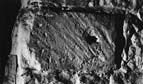
A small fragment with only one original face visible and one original edge surviving. Evidence of decoration consists only of signs of a border along one edge and a grid of holes that are the bases of interstices in an interlace pattern.
It is not possible to say what form of monument this piece came from or to make sense of the interlace pattern, except that it might perhaps be either a broad mat of interlace or a run at right angles to the stone's edge, similar to that found on covers of the mid-Kesteven type (see Chapter V and Fig. 9) or on the Brattleby 1 cross-shaft (Ills. 60–4, 66–7).
Its secondary use in an architectural feature that has been taken to be original in a late eleventh-century tower suggests that it was originally carved before the mid eleventh century.
