Select a site alphabetically from the choices shown in the box below. Alternatively, browse sculptural examples using the Forward/Back buttons.
Chapters for this volume, along with copies of original in-text images, are available here.


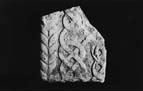
Object type: Part of grave-cover [1]
Measurements:
L. 33 cm (12.5 in) W. 28.5 cm (11.25 in) D. 7.5 cm (3 in)
Stone type: Pale yellow (10YR 7–8/4) fine-grained, silty limestone, of grain size 0.2 mm or less, with quartz grains glinting on fractured surface. No fossils seen. Greetwell Member, Lower Lincolnshire Limestone, Inferior Oolite Group
Plate numbers in printed volume: Fig. 14; Ill. 279
Corpus volume reference: Vol 5 p. 221-222
(There may be more views or larger images available for this item. Click on the thumbnail image to view.)
A fragment from the centre of a flat rectangular grave-cover of Lindsey type, decorated in low relief and only on the upper surface.
A (top): A border against face B is defined by a twin cable moulding in a herringbone pattern, and the central panel is occupied by the remains of two interconnecting lines of simple pattern F interlace, which produce a repetitive figure-of-eight pattern in two incomplete rows. The single surviving figure-of-eight unit measures 18 × 11.5 cm (7 × 4.5 in): the layout and spacing of the lines and rows appears regular and well-organised. The decoration stands sharply as a squared U section against a flat cut-away background.
B (long): Undecorated, but original dressed surface.
C (end) and D (long): Regular surface resulting from splitting for reuse.
E (end): Irregularly broken.
F (bottom): Dressed to an original surface.
This is part of an interlaced cover of Lindsey type, discussed in Chapter V. It belongs to the sub-group (a) distinguished by their double cable or herringbone border (Table 6). The cover has clearly been broken up for reuse as building stone by splitting.
A split across the cover was positioned between the rows of figures-of-eight and produced face C at a good right angle to the original edge of the cover: a split lengthways was positioned through the crossings of the second line of interlace to produce face D at right angles to C and parallel to the cover's edge. The latter strongly suggests that there were three decorative lines of interlace on the original cover, as typically with this monument type, and the lengthways splitting divided it in half. On that basis this cover was 56–60 cm (22–23.5 in) wide, thereby conforming closely to the norm for the type. Precisely this process of splitting of the same class of covers is evidenced by Manby 1 and Broughton 1, for example (Ills. 284, 69), and by the preparatory groove on Theddlethorpe St Helen 1 (Ills. 370–1).
