Select a site alphabetically from the choices shown in the box below. Alternatively, browse sculptural examples using the Forward/Back buttons.
Chapters for this volume, along with copies of original in-text images, are available here.


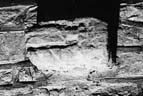
Object type: Part of grave-cover(?)
Measurements: L. c. 30 cm (011.8 in) W. c. 15 cm (5.9 in) D. c. 12 cm (4.7 in)
Stone type: [Inaccessible but apparently Ancaster Freestone, Upper Lincolnshire Limestone, Inferior Oolite Group]
Plate numbers in printed volume: Fig. 9; Ills. 280–2
Corpus volume reference: Vol 5 p. 222
(There may be more views or larger images available for this item. Click on the thumbnail image to view.)
A small fragment from a much larger monument decorated with cable moulding and interlace.
A (top): Within the cable-moulded border, the face is divided into two panels by a transverse band of double cable. Decoration is only visible in one of the two panels thus created and here it is very indistinct – a loop is recognisable but little else.
B (long): Adjacent to the cable-moulded border is a rather incompetently laid-out run of plain three-strand plait.
This fragment is not easy to interpret. The cable-moulded border and the division of face A into two panels by a double cable moulding both suggest that this could be a fragment from a grave-cover which was related to the mid-Kesteven group (and it has been reconstructed as such on Fig. 9). In such an interpretation face B would represent decoration on the flank of the monument (perhaps a run of interlace developing from a bull's head) whilst the indeterminate decoration on face A would represent the 'lid' – perhaps interlace decoration within the interstices of the central cross. The interlace on this fragment, however, is not of high quality and the two interlace panels do not seem to be in the usual relationship to each other (see Chapter V), so, although it could be from a cover of mid-Kesteven type, too little of the stone is visible for a conclusive identification. If this is from a mid-Kesteven cover then a date between the mid tenth century and the early eleventh would be appropriate, but, if not, a later date may apply.
