Select a site alphabetically from the choices shown in the box below. Alternatively, browse sculptural examples using the Forward/Back buttons.
Chapters for this volume, along with copies of original in-text images, are available here.


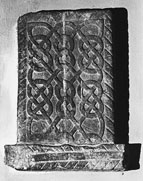
Object type: Part of grave-cover, in two pieces now joined together
Measurements:
a: L. 65 cm (25.5 in) W. 23 > 22 cm (9 > 8.75 in) D. > 9.5 cm ( > 3.75 in)
b: L. 66 cm (26 in) W. 24 cm (9.5 in) D. > 9.5 cm ( > 3.75 in)
Stone type: [Lincolnshire Limestone but not Ancaster or Barnack types]
Plate numbers in printed volume: Fig. 14; Ill. 284
Corpus volume reference: Vol 5 p. 224
(There may be more views or larger images available for this item. Click on the thumbnail image to view.)
The two stones form adjacent parts of the same grave-cover. They have been reconstructed immediately abutting, whereas 2.5 to 5cm (1 to 2 in) has been lost in the longitudinal splitting of the cover for secondary use (see Fig. 14). Allowing for that, the pattern matches perfectly and the stones make one end (perhaps the foot) of a flat, rectangular or slightly tapering cover of Lindsey type decorated only on its upper surface.
A (top): The border is defined by a single cable moulding, and the central field is occupied by three interconnecting lines of simple pattern F interlace, which produce a repetitive figure-of-eight pattern in three incomplete rows, with the terminals cross-joined at the surviving end. The figure-of-eight units measure 19 × 11.5 cm (7.5 × 4.5 in).
The layout and spacing of the lines and rows is competently regular, but there is a markedly larger gap between the second and third surviving row. The decoration stands sharply as a squared U section against the flat cut-away background.
B and D (long): Undecorated but with slightly bowed or battered section.
C (end): Undecorated original end of cover.
E (end): Built in, but carefully cut for secondary use.
F (bottom): Built in.
This is one of the interlace covers of Lindsey type discussed in Chapter V. It belongs to the sub-group (b) distinguished by its single cable border (Table 6). Its original width of approximately 50cm (19.75 in) is closely comparable to the norm for the type of cover. This example's fine finish and carefully shaped long edges perhaps echo features more characteristic of sub-group (a); the apparently deliberate extra-large gap between rows two and three finds a parallel at North Thoresby (Ill. 313).
