Select a site alphabetically from the choices shown in the box below. Alternatively, browse sculptural examples using the Forward/Back buttons.
Chapters for this volume, along with copies of original in-text images, are available here.


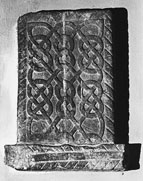
Object type: Part of grave-marker
Measurements: H. 59 cm (23.25 in) W. > 12 cm (4.75 in) D. 10 > 12 cm (4 > 4.75 in)
Stone type: [Lincolnshire Limestone but not Ancaster or Barnack types]
Plate numbers in printed volume: Ill. 284
Corpus volume reference: Vol 5 p. 224-225
(There may be more views or larger images available for this item. Click on the thumbnail image to view.)
Part of an upright rectangular grave-marker, of which more than three-quarters is concealed in the wall in which it has been reset. Only one original edge is visible.
A and C (broad): Both faces have been recut, removing all decoration.
B (narrow): The visible face is slightly tapered and is decorated with two cabled-moulded borders. At one end is an area of damage or roughening but the cabling appears to terminate against it, so it is probably the foot of the marker intended to be earthfast.
D (narrow): Built in.
E (top): Broken or split for reuse.
F (bottom): A small rebate in this end indicates secondary use of the stone.
This is probably one of the Lindsey group of closely similar rectangular markers found with a restricted distribution in Lincoln city and Lindsey (see Chapter V and Table 7A). Similar cable moulding is found on the narrow faces of Gayton le Wold (Ills. 180–4), Hackthorn 2 (Ills. 190–4), Lincoln Cathedral 2 (Ills. 232–4), and Lincoln St Mark 16 (Ills. 257–60). The occurrence of this type of marker at three sites, including Manby, with Lindsey-type covers (Chapter V, and see Manby 1 above) may suggest that they functioned as head-stones in grave suites with these covers. Their width matches closely the norm to which the covers aspire and they would have provided the cross motif which is so noticeably lacking from those covers' decoration.
