Select a site alphabetically from the choices shown in the box below. Alternatively, browse sculptural examples using the Forward/Back buttons.
Chapters for this volume, along with copies of original in-text images, are available here.


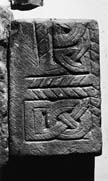
Object type: Part of grave-cover
Measurements: L. 64 cm (25.2 in) W. 43 > 40 cm (16.9 > 15.7 in) D. 40 > 39 cm (15.7 > 15.3 in)
Stone type: [Ancaster Freestone, Upper Lincolnshire Limestone, Inferior Oolite Group]
Plate numbers in printed volume: Fig. 9; Ills. 34–7
Corpus volume reference: Vol 5 p. 105-106
(There may be more views or larger images available for this item. Click on the thumbnail image to view.)
A section from a large grave-cover of mid-Kesteven type. This fragment has been reused as a tank, possibly a font, in the post-Conquest period. It has been carefully hollowed out to make a container over 30cm deep, with walls approximately 4cm thick. This container has also had two holes drilled through its base and (presumably subsequently) it has had a large irregular hole knocked through its base.
Face F (bottom) has been completely recut (presumably to give the tank a steady base). Face C (end) is an undecorated original surface, but face E (end) has been smoothly recut. The original decoration on face A (top) is reduced to the slight remains of its two cable-moulded borders along the lip of the tank. The ornament on the remaining parts of the two long faces (B and D) survives in good condition, decorating, as it were, the sides of the container. This decoration is interlace in low relief.
B (long): The angle between the lid and the side is cable moulded. Within, the face is divided into the characteristic arrangement of two panels – one long and horizontal and one transverse and vertical – by a vertical band of double cable moulding. The transverse panel contains an asymmetric interlace motif of type i (Fig. 10) with a medial line. The long horizontal panel contains the start of a run of interlace bounded on the lower side by a cable moulding within the undecorated plinth. The interlace itself is consequently off-centre and begins with a type vii motif (Fig. 10). Beyond this initial motif, the run appears to develop as a three-strand plait.
D (long): Between the cable moulding marking the junction between the side and lid of the monument and the zig-zag decorated plinth, the face is divided into two panels – a transverse panel at one end and a longer horizontal one – by a double cable moulding. In the transverse panel there is an interlace knot of type viii (Fig. 10). The interlace in the long horizontal panel also begins with a pattern E knot and a free ring, but this is the start of a four-strand design, probably plaitwork. The interlace strands in both panels have an incised medial line.
Both the style and layout of the surviving decoration indicate quite clearly that the stone represents one end of a large mid-Kesteven type cover (Chapter V). Faces B and D represent the long sides and carry decoration typical of these panels in many other members of the group (see Fig. 9). The mid-Kesteven covers are dated to between the mid tenth and early eleventh century.
Bassingham 1 and 2 (below, Ills. 38–40) are usually said to be a part of the same original monument. Although the two stones represent two very similar grave-covers, they cannot have come from the same original, as both stones represent the side panels of their respective monuments and their decoration is incompatible. No. 1 has a single register of decoration and no. 2 has two.
The reuse to which no. 1 has been put is distinctive. It is unclear what was the purpose of the carefully made 'tank'. Cole saw it as the original font of the church (1897–8, 387) and this proposal has been explored in detail (Stocker 1997b). There are parallels for the reuse of earlier stones for this purpose (as fonts) and it has been suggested that the intricate liturgical connections between baptism and burial in the Middle Ages have lead to quite a number of well-documented cases of the burial of old fonts within churches, like the Bassingham example, once their useful life was over (ibid.). It is possible, however, that the recutting of the grave-cover was intended for a 'child's' coffin, though one might have expected Cole to have recorded that a burial was found inside the tank, had one been present when discovered. Nevertheless, the fact that the container is so carefully fashioned out of the grave-cover, and the interlace decoration has been carefully preserved on its sides, suggests that it was intended to be visible in its secondary use as a tank and this in turn suggests that its secondary use is, to some extent, 'iconic' (Stocker with Everson 1990, 95–6).
