Select a site alphabetically from the choices shown in the box below. Alternatively, browse sculptural examples using the Forward/Back buttons.
Chapters for this volume, along with copies of original in-text images, are available here.


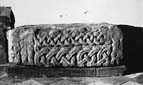
Object type: Part of grave-cover
Measurements: L. 75 cm (29.5 in) W. 40 > 39 cm (15.7 > 15.3 in) D. 27 > 24 cm (10.6 > 9.4 in)
Stone type: [Ancaster Freestone, Upper Lincolnshire Limestone, Inferior Oolite Group]
Plate numbers in printed volume: Fig. 9; Ills. 38–40
Corpus volume reference: Vol 5 p. 106
(There may be more views or larger images available for this item. Click on the thumbnail image to view.)
This fragment has been recut as a plinth and consequently has a deep chamfer cut along the arris between faces A (top) and D (long). It has been split in half longitudinally for this secondary use, in addition to having been cut horizontally into several pieces. Faces A (top) and C–F (long side, ends and bottom) have been recut so that no original surface remains. Original decoration survives only on face B, where it consists of interlace in low relief.
B (long): The upper angle of the stone is badly damaged and it is not possible to confirm that it was cable moulded. The lower angle is missing altogether. The field is divided near the end of the surviving fragment into two panels by a vertical band of double cable moulding. The interlace in the damaged transverse end panel consisted of a run of four-strand plait with a medial line, disposed as, for example, motif type v (Fig. 10). The long horizontal panel retains two runs of interlace. Towards the upper angle of the stone is a tight run of three-strand plait originating in a 'bull's head' (Fig. 11) of which very little now survives. An early photograph, however (Cole 1897–8, facing p. 387) shows this bull's head clearly, with a nose band in relief. This end of face B has been broken away since 1897. The run of plait developing from the bull's horns is unornamented. The free end of this plait connects with the lower run of more expansive four-strand interlace below, which also incorporates a free ring and a pattern E knot just before it passes under the 'nose' of the bull's head. In this more restricted zone the damage to the stone makes the exact detail unclear, but the strands have an incised medial line.
The decoration on this stone has many characteristics of layout, style and detail of the mid-Kesteven group of grave-covers (Chapter V and Fig. 9) and there can be little doubt that the surviving decorated face is the side-panel of a large specimen from this group. It appears, however, that it cannot be another part of the same monument represented by no. 1 above, but is part of a second, perhaps even larger, cover of the same type. This group of monuments is dated to between the mid tenth and early eleventh century.
