Select a site alphabetically from the choices shown in the box below. Alternatively, browse sculptural examples using the Forward/Back buttons.
Chapters for this volume, along with copies of original in-text images, are available here.


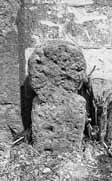
Object type: Grave-marker
Measurements: H. 59 cm (23.25 in); W. disc head 30 cm (11.75 in); shaft 28 > 26 cm (11 > 10.25 in); D. 21 cm (8.25 in)
Stone type: Olive grey to brownish yellow (10YR 6/8), cavernous-weathered soft ferruginous limestone. Tealby Limestone, Lower Cretaceous of Lincolnshire
Plate numbers in printed volume: Ills. 392–3
Corpus volume reference: Vol 5 p. 275
(There may be more views or larger images available for this item. Click on the thumbnail image to view.)
A disc-headed marker with shouldered and tapering shaft. Around the edge of the disc head is a broad flat fillet occupying the central third of the width; it has no sign of decoration.
A (broad): Decorated on the disc with a cross in low relief; its arms of type E8 are attached to a central ring.
B and D (narrow): Undecorated except for the moulding on the head.
C (broad): Not visible.
Appendix A item (stones dating from Saxo-Norman overlap period or of uncertain date).
This is a marker type of common occurrence in Lincolnshire. Close parallels, though with slightly different cross types, exist locally at Cabourne. The type is found in significant numbers in north-east England, as at Birtley 3 (Cramp 1984, pl. 232, 1314), Chollerton 2 (ibid., pl. 234, 1331), Newcastle-upon-Tyne 1 (ibid., pls. 248, 1371 and 249, 1376), Warden 5 (ibid., pl. 255, 1391–3) and Woodhorn 4 (ibid., pls. 258, 1404 and 259, 1405), all Northumberland, and there taken to date to the late eleventh century. The Newcastle piece has an archaeological context of reuse before 1178. A similar marker is known also at Cleator 1, Cumberland (Bailey and Cramp 1988, ills. 624–7) and reckoned of late eleventh to mid twelfth-century date. Passing observation suggests that such markers are of widespread occurrence in southern and midland England no less than in the north. In the Lincolnshire context, the stone type may also suggest a post-Conquest date.
This marker may have stood as a pair with Beelsby 2 in a single complex monument or grave suite.
