Select a site alphabetically from the choices shown in the box below. Alternatively, browse sculptural examples using the Forward/Back buttons.
Chapters for this volume, along with copies of original in-text images, are available here.


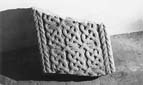
Object type: Part of grave-cover [1]
Measurements: L. 53 > 39 cm (21 > 15 in) W. 58 > 57 cm (23 > 22.5 in) D. 16 cm (6 in)
Stone type: [Lincolnshire Limestone but not Ancaster or Barnack types]
Plate numbers in printed volume: Fig. 14; Ills. 53–4
Corpus volume reference: Vol 5 p. 110
(There may be more views or larger images available for this item. Click on the thumbnail image to view.)
A fragment from the middle of a flat, slightly tapering grave-cover of Lindsey type decorated in low relief and only on the upper surface.
A (top): The border is defined by a twin cable moulding in a herringbone pattern, and the central panel is occupied by three interconnecting lines of simple pattern F interlace, which produce a repetitive figure-of-eight pattern in four incomplete rows. The figure-of-eight units measure 18 × 11.5 cm (7 × 4.5 in): the layout and spacing of the lines and rows is competently regular. The decoration stands sharply as a squared U section against the flat cut-away background in a manner typical of the cover type.
B and D (long): Undecorated, but worked into a bowed section.
C and E (ends): Broken.
F (bottom): Roughly dressed and with a regular rebate of rectangular section cut in secondary use.
This is one of the interlace covers of Lindsey type discussed in Chapter V above. It belongs to sub-group (a), distinguished by its double cable or herringbone border (Table 6). Its width closely matches that of North Thoresby 1 (Ill. 313) and stands at the upper end of the range of approximately 50–60cm (20–24 in) that was the norm. It is typical of this sub-group in its fine finish and good layout, which extend to the carefully bowed edges that it shares with the example from Lincoln St Mark (no. 4, Ill. 241).
