Select a site alphabetically from the choices shown in the box below. Alternatively, browse sculptural examples using the Forward/Back buttons.
Chapters for this volume, along with copies of original in-text images, are available here.


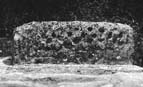
Object type: Part of grave-cover(?)
Measurements: L. 56 cm (22 in) W. 33 cm (13 in) D. 42 cm (16.5 in)
Stone type: Pale yellowish grey (10YR 8/2) oolite grainstone, of closely packed 0.4mm ooliths. Ancaster Freestone, Upper Lincolnshire Limestone, Inferior Oolite Group
Plate numbers in printed volume: Fig. 9; Ills. 55–6
Corpus volume reference: Vol 5 p. 110-111
(There may be more views or larger images available for this item. Click on the thumbnail image to view.)
Only one decorated surface is visible and that only to the extent that the stone protrudes or is offset south from the wall face (19 cm (7.5 in)). That decoration faces up, and has been severely weathered and pitted by dripping water. The exposed vertical face is recut, as is the stone's section that is visible in the west aspect of the quoin. The stone is rectangular in section, but since the present south face has been recut it may have been somewhat nearer to square. There is no sign of a moulding on any of the corners.
B (long): The sole visible decoration comprises a panel of interlace in a changing pattern, with a central unit of simple pattern F whose two loose strands at either end cross over within a free ring. The panel is outlined by a double border of flat section that longitudinally divides this run of interlace from the narrower field of decoration now covered by the nave quoin, and also turns across one end of the panel. At the same (east) end a third border of more rounded section and perhaps with a trace of cabling lies across the stone.
The size and section of this piece at first suggests that it is part of a cross-shaft. The panel of interlace finds a parallel in both organisation and pattern and multiple borders with the narrow faces of the shaft at Brattleby nearby down the limestone ridge, which is also in a stone of Ancaster type (Ills. 60–4, 66–7). But the interlace occupies little more than half the width of the stone and must have been matched by a second parallel run. There are also no edge mouldings. This raises the alternative and more plausible possibility that this is part of a large, chest-like grave-cover of the mid-Kesteven group (see Chapter V), also standardly found in stone of Ancaster type. The surviving face would be part of the long side of such a monument (see reconstruction in Fig. 9). Typically such sides are decorated with asymmetrical runs of interlace, narrow above broad, that can be separated by longitudinal rolls or fillets. A similar combination of simple pattern F and free rings is used in the lower interlace fields on Burton Pedwardine3 and Lincoln St Mary-le-Wigford 2 (Ills. 77, 271). The additional border at one end could be understood as the division from a vertical end panel, which typically has a double-cabled form. Because of the poor preservation here this interpretation is not certain, but with the additional detail of the appearance of the stone's section, seems the best available. Though it is not immediately obvious, this is a clear-cut if fragmentary mid-Kesteven cover. The location of reuse, as a protruding basal quoin stone, is the same as Normanton on Cliff 1, and compares more generally with reuse in quoins at Creeton or Ruskington.
