Select a site alphabetically from the choices shown in the box below. Alternatively, browse sculptural examples using the Forward/Back buttons.
Chapters for this volume, along with copies of original in-text images, are available here.


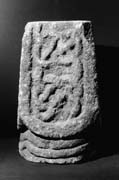
Object type: Shaft fragment [1]
Measurements: H. 39.5 cm (15.5 in) W. 22.3 > 19.5 cm (8.75 > 7.6 in); (below swag) 20 cm (7.75 in) D. 20.3 > 15.3 cm (8 > 6 in)
Stone type: As Gilling West 1 (St Agatha), except that this is a fine-grained variety, feldspathic and micaceous. The colouring is not uniform and varies from brownish yellow (10YR 6/8) to yellow (10YR 7/8).
Plate numbers in printed volume: Ills. 266–71
Corpus volume reference: Vol 6 p. 114
(There may be more views or larger images available for this item. Click on the thumbnail image to view.)
The swag of a round-shaft derivative.
A (broad): The edge moulding of the upper part and the swag is broad and tapers upwards. The panel contains two registers of pattern F interlace with a glide between in fleshy modelled strand. Below the swag the shaft is recessed and cylindrical in section. It has three parallel modelled strands, each 1 inch (2.5 cm) wide, which are caught up into the corners of the swag.
B (narrow): Edge mouldings and swag are as on face A. The panel contains a twisted serpent whose ribbon body is modelled and median-incised. Its head is seen from above and hangs to the bottom right-hand corner. It has prominent globular eyes and a long jowl (contra Collingwood's fig. k). Below the swag, as all other faces.
C (broad): The mouldings and swag as above. The panel contains a pair of wing-shaped motifs suspended from a horizontal double strand with return loops. The strands are well modelled and the vertical elements pass upwards through the return loops to cross in a saltire (contra Collingwood's fig. l). The wings have a narrow edge moulding.
D (narrow): The mouldings and swag as above. The panel contains median-incised three-cord plait in broad strand. The lowest loop lies close to the other strand's terminal loop and hangs free; it may be the tail of a ribbon beast.
This piece's importance lies in its similarities to the Gosforth cross in Cumbria (Bailey and Cramp 1988, 100–4). The form of the shaft, cylindrical below a swag and tapering in rectangular section above, is exactly that of its Cumbrian counterpart and the scale is also comparable. The pendant wing motif may be compared with Gosforth 1D (ibid., ill. 306) where the multiple wings of the dragon's body are locked in rings. The parallel horizontal bars with return loops of face C are also the principal element of the ring-knot on the hogback, Gosforth 4C (ibid., ill. 322). Zoomorphic interlace, like that on face B, is a feature of the Gosforth master's work on both the cross and the hogback Gosforth 5A (ibid., ills. 298 and 328), though the Gilling ribbon beast is identical with those of Birkby 1 (Ill. 22). The quality of carving is high, with modelled relief standing from dressed backgrounds, again in the Gosforth manner. Gilling West is close to the Stainmore road into Cumbria. The Birkby animals provide the only local analogues for the motifs of this piece; the repertoire is more Cumbrian than Yorkshire, though see also Ellerburn 5 (Lang 1991, 128, ill. 432).
