Select a site alphabetically from the choices shown in the box below. Alternatively, browse sculptural examples using the Forward/Back buttons.
Chapters for this volume, along with copies of original in-text images, are available here.


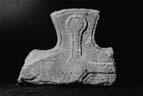
Object type: Part of cross-head [1]
Measurements: H. 32.3 cm (12.7 in) W. 43.7 cm (17.2 in) D. 16 cm (6.2 in)
Stone type: Coarse-grained feldspathic Millstone Grit; yellow (10YR 7/6) but partly burnt to a red colour (2.5YR 5/8). This could have been obtained from one of the local Roman fortifications (i.e. Catterick), and therefore originally from the Northern Pennines (possibly Red Scar Grit from Wensleydale), or possibly newly cut stone from the watershed area between Teesdale and Swaledale, near Barningham.
Plate numbers in printed volume: Ills. 272–6
Corpus volume reference: Vol 6 p. 115
(There may be more views or larger images available for this item. Click on the thumbnail image to view.)
The upper and most of the right limb of a cross-head.
A (broad): A free-armed cross with wide curved arm-pits and slightly convex tips, type E10. There is a modelled edge moulding. Within the plain cross is a raised lorgnette cross with narrow edge moulding and circular terminals and centre, perhaps once bulbous.
B (narrow): Plain and broken.
C (broad): As face A.
D (narrow): Broken.
The lorgnette (or spine-and-boss) cross is a skeuomorph of a metal appliqué and it was a common device on crosses from the Anglian period to the Anglo-Scandinavian (Chapter VI), so it is not an indication of date. It is common on both sides of the Pennines (Collingwood 1927a, 93–8). Collingwood reconstructed the cross using no. 2 as its shaft (ibid., 7, fig. 13.7) but geologically this is unlikely. The form of the whole cross-head suggests a pre-Viking date.
