Select a site alphabetically from the choices shown in the box below. Alternatively, browse sculptural examples using the Forward/Back buttons.
Chapters for this volume, along with copies of original in-text images, are available here.


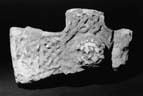
Object type: Cross-head fragment [1]
Measurements: H. 26.5 cm (10.4 in) W. 46 cm (18.1 in) D. 17 cm (6.7 in)
Stone type: As Gilling West 1 (St Agatha)
Plate numbers in printed volume: Ills. 280–4
Corpus volume reference: Vol 6 p. 115-116
(There may be more views or larger images available for this item. Click on the thumbnail image to view.)
A (broad): Collingwood's drawing (1907, fig. b) shows lost features. The cross has wide curved arm-pits with splayed arms and slightly convex tips: type E10. It also had a recessed ring, of which only the stumps remain on the lateral arm. The edge moulding is narrow and modelled. In the centre is a damaged raised boss which is covered in modelled interlace, once a ring-knot with two concentric rings and return loops (see Collingwood's drawing). The interlace surrounding the boss had changing patterns (E and F) in a continuous narrow modelled strand.
B (narrow): Broken.
C (broad): Very similar to face A but much scraped. The domed boss stood proud by 1 inch at least, with the four return loops pendant on its convex sides (Collingwood 1907, fig. c).
D (narrow): A very worn arm-tip. Within the arm-pits are punch-mark dressing scars.
Originally, this was a well-carved, controlled piece. The plastic relief of the interlace and its openness would be acceptable Anglian features, but the ring-head and the ring-knot of the boss demonstrate its Anglo-Scandinavian character. It represents Anglian survival in the Viking Age. The two concentric rings of the knot on the bosses may have provided the model for the more clumsy versions of no. 1 above.
