Select a site alphabetically from the choices shown in the box below. Alternatively, browse sculptural examples using the Forward/Back buttons.
Chapters for this volume, along with copies of original in-text images, are available here.


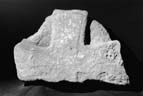
Object type: Part of cross-head [1]
Measurements: H. 34.5 cm (13.6 in) W. 54.5 cm (21.4 in) D. 15 cm (5.9 in)
Stone type: As Gilling West 1 (St Agatha), except that this example is flaggy sandstone with very good bedding parallel to the main cross face, and it has been extensively burnt. Original colour yellowish brown to very pale brown (10YR 5/6–7/4), burnt to yellowish red (5YR 5/6).
Plate numbers in printed volume: Ills. 277–9
Corpus volume reference: Vol 6 p. 115
(There may be more views or larger images available for this item. Click on the thumbnail image to view.)
A (broad): A plate-head cross with three limbs surviving. The arm-pits are broad Vs and the arms are splayed: type B6. The edge moulding is very worn but was broad and modelled. There is now no surviving evidence of the lorgnette (or spine-and-boss) cross drawn by Collingwood (1907, fig. f), such is the heavy erosion. The plate is recessed and hollowed slightly in the arm-pits.
B (narrow): Broken and worn. The plate has a bevelled section.
C (broad): Very worn indeed, but as face A.
D (narrow): Broken and worn.
E (top): The tip of the upper limb has a modelled edge moulding and may have contained some interlace. It is now worn.
The piece has eroded badly since Collingwood's drawing. It is regrettable that the lorgnette cross is lost, for its occurrence on a plate-head would have been rare (Collingwood 1927a, 97–8). The plate-head form is common in nearby Allertonshire (Chapter IV), and suggests an Anglo-Scandinavian context, with the lorgnette being an Anglian survival.
