Select a site alphabetically from the choices shown in the box below. Alternatively, browse sculptural examples using the Forward/Back buttons.
Chapters for this volume, along with copies of original in-text images, are available here.


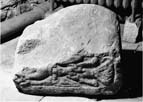
Object type: Hogback fragment
Measurements: L. 57.1 cm (22.5 in) W. (at ends) 47 and 41.3 cm (18.5 and 16.25 in) H. 40 cm (15.7 in)
Stone type: As no. 1, but with pebbles in the fabric up to 15mm in size; also the base has been burnt to a yellowish red (5YR 5/6) colour.
Plate numbers in printed volume: Fig. 13; Ills. 23–25
Corpus volume reference: Vol 6 p. 61-62
(There may be more views or larger images available for this item. Click on the thumbnail image to view.)
Only one face illustrated by Longstaffe; other faces not recorded.
A (long) : There were three rows of type 7 tegulae, and below the eaves a horizontal panel of scroll and pellet, the pellets in clusters.
B (end) : The gable end has straight diagonal pitches and vertical sides. The worn ridge hardly protrudes. Within a worn modelled edge moulding is a panel filled with a group of figures, the central one seated in a chair with large bossed terminals. One of the flanking figures may carry a ring and in the lap of the seated figure is a crescent-shaped object.
C (long) : The roof pitch is terminated at the gable by a broad modelled moulding and contains four rows of type 4 tegulae. The eaves are marked by a modelled edge moulding which frames the long side panel which contains at the left two serpentine dragons in profile, knotted together in symmetrical loops. Their heads face outwards, with high domed brows and jaws which touch their tails. In the centre of the panel, originally, is an arched niche in modelled strand, with a rough capital on the left. Within it is the frontal bust of a human figure, much worn.
D (end) : Broken away.
This is a type k hogback, the enriched shrine variety, though it does have illustrative carving on face A, linking it to type g. The bound, flying figure is Weland (O.N. Völundr) the Smith (Lang 1976, 92–3), which has close parallels at Leeds, West Riding, and Sherburn in the East Riding (ibid., 90–2, fig. 7). Such heroic Germanic imagery is limited in Northumbria to these three scattered sites, all on monuments of the Anglo-Scandinavian period (Lang 1991, 37, 203, ills. 768, 920). The Scandinavian parallels are much earlier and equally sparse. The interpretation of the figures on the gable end may be related to the Weland myth, or even to Christian iconography such as the Epiphany, but the details are so worn that it is better to leave it enigmatic. The ornament on face C, with its ribbon beasts and portrait bust, has a very Anglian appearance and demonstrate the tenacity of the tradition in the Viking Age.
