Select a site alphabetically from the choices shown in the box below. Alternatively, browse sculptural examples using the Forward/Back buttons.
Chapters for this volume, along with copies of original in-text images, are available here.


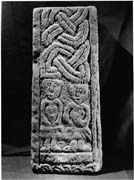
Object type: Part of cross-shaft [1] [2]
Measurements: H. 73 cm (28.7 in) W. 31.5 > 27.3 cm (12.4 > 10.7 in) D. 21.3 cm (8.4 in)
Stone type: Medium-grained, well sorted sandstone, with sub-angular grains. Yellowish brown (10YR 5/4–5/6). Deltaic sandstone from the Saltwick Formation, Aalenian, Middle Jurassic. The nearest source of this quality sandstone is the escarpment of the Cleveland Hills to the south-east of Kirklevington near Ingleby Arncliffe and particularly above Swainby (on the continuation of the pre-Roman regalis via track which passes through Kirklevington and Crathorne).
Plate numbers in printed volume: Ills. 400–3
Corpus volume reference: Vol 6 p. 141-142
(There may be more views or larger images available for this item. Click on the thumbnail image to view.)
A (broad) : The edge moulding is broad and flat. On the right, what appears to be median incision is a flaw in the stone. In a long panel is a ring-twist with a Stafford knot terminal in broad flat strand, median-incised in picked work. Below this are two crudely cut frontal figures with pear-shaped heads and incised features. From round shoulders their arms hang to accentuate a heart-shaped chest. The knee-length kirtle is splayed, with diagonal ridged folds. The feet are turned outwards. They stand on a broad transverse moulding contained within the panel. Below it are remains of median-incised loops.
B (narrow) : The edge moulding is as on face A. A long panel contains Como-braid (S-twist) in median-incised strand; the hole-points are not gridded. The base of the panel has an integral transverse flat moulding, below which is a median-incised strand: one much worn register of interlace.
C (broad) : Largely worn away, except for part of a broad flat edge moulding at the top right. Within the panel are remains of closed circuit interlace in broad, flat, median-incised strand.
D (narrow) : Similar edge mouldings to those of the other faces contain a long panel of four-cord closed circuit interlace in median-incised strand. The outer resolution is a pattern D terminal; the inner, a symmetrical pattern F loop. At two points there are natural depressions in the stone into which the carving descends. Slight remains of gesso and red pigment adhere. At the base is a transverse moulding below which are slight remains of median-incised strand.
The shaft copies the more competent crosses of the Allertonshire workshop (see Chap. VI, p. 44). There is no gridding but the ornamental repertoire of frontal figures, closed circuit and Como-braid was close at hand. The pair of figures are male to judge from their kirtles, and resemble those of Gainford 1 (Cramp 1984, 80, pl. 57, 278), on the north bank of the Tees.
[1] The following are general references to the Kirklevington stones: Browne 1880–4, cx, cxii; Young 1882, 458; Allen and Browne 1885, 352; Frank 1888, 44; Bulmer 1890, 162; Hodges 1894, 195; (—) 1896–1905a, viii; Lofthouse 1896–8, 16; (—) 1899–1900b, 250; Morris, J. 1904, 228–9, 420; Collingwood 1908, 120; Page, W. 1923, 262; Morris, J. 1931, 229, 417; Elgee and Elgee 1933, 217, 248; Mee 1941, 136; Pevsner 1966, 221; Morris, C. 1976a, 143–4; Brown, M. 1979, 44; Horton 1979, 195; Bailey 1980, 252, 255, 265; Cramp 1984, 30; Lang 1991, 42, 214; Daniels 1995, 81; Stocker 2000, 200–3.
[2] The following is an unpublished manuscript reference to no. 1: BL Add. MS 37552 no. XIV, item 649 (Romilly Allen collection).
