Select a site alphabetically from the choices shown in the box below. Alternatively, browse sculptural examples using the Forward/Back buttons.
Chapters for this volume, along with copies of original in-text images, are available here.


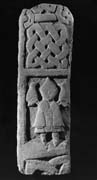
Object type: Upper part of cross-shaft [1] [2]
Measurements: H. 79.8 cm (31.4 in) W. 24 cm (9.4 in) D. 18.5 cm (7.3 in)
Stone type: Fine-grained, well sorted, micaceous sandstone with sub-rounded grains. Light yellowish brown (2.5Y 6/4). Deltaic sandstone from the Upper Carboniferous (probably Coal Measures, Westphalian B). This suggests a more distant origin than no. 1, probably from a co. Durham source.
Plate numbers in printed volume: Ills. 399, 404–7
Corpus volume reference: Vol 6 p. 142-143
(There may be more views or larger images available for this item. Click on the thumbnail image to view.)
A (broad) : The right-hand side is damaged. On the left is a broad modelled edge moulding which turns to form the neck of the shaft. A broad horizontal moulding stems from it at this point and is locked by a ring. Above the transverse moulding are two terminal loops of interlace in deeply modelled strand with the remains of drilled hole-points. The right-hand locking ring survives. (i) Below is a panel of closed circuit interlace in the same strand (1 inch wide) with very deep hole-points. The pattern is a ring-knot, the ring being diamond-shaped, threaded by a twin link. Below is a transverse moulding. (ii) In the panel below is a frontal human figure, deeply modelled (0.75 inch in relief), who wears a conical cap. The features are incised: a horizontal slit for the mouth, and the eyes and nose in a continuous line forming a 'hook and eye' motif. The lightly modelled ears are drilled in the centre. His arms hang vertically. He wears a flared smock to knee level, which has a neck slit and expanded sleeves. His finger tips poke out from the sleeves. His chunky legs have pointed feet extended towards the viewer and they stand on a very broad inclined border. On his shoulders perch two birds with short legs, no tails, and folded wings which have a hatched surface. (iii) Below the border are remnants of two box-point terminals in broad flat strand.
B (narrow) : Largely scabbled, except the very top where locking rings and transverse mouldings survive.
C (broad) : Scabbled. Some hole-points may survive.
D (narrow) : Locking rings and transverse moulding survive. At the top, thinner interlace strands with free ends float upwards. There may be something of a knitting stitch loop. Below, it is scabbled with mortar adhering.
This is very accomplished carving, of a standard superior to most Anglo-Scandinavian pieces in Yorkshire. The planning of the ornament is tight and regulated by a grid (see Chapter VI), though it is the figure carving's plasticity which is most striking, as Rosemary Cramp rightly notes, having 'the solidity and volume of the figure carving on the high crosses of tenth-century Ireland' (Cramp 1972, 147–8). The shaft is the most notable of the Allertonshire workshop, with its trademark of the locking ring (Chapter VI), and there are close parallels at Sockburn and Brompton where frontal human figures are found carved almost in the half-round (Ills. 37, 40, 44; Cramp 1984, pl. 134, 726).
The iconography of the birds must remain a matter of debate. Collingwood (1907, 352; 1927a, 163) considered them doves and the man a portrait, presumably of the deceased. A more stylised version was once visible on Billingham 1 (Cramp 1984, 48, pl. 15, 68–9), but the naturalism and the details of secular civilian dress on Kirklevington 2 may confirm Collingwood's view. The Allertonshire parallels are all military in their dress and accoutrements. An alternative interpretation suggests that the figure is Óðinn and the birds his ravens, and there is Óðinn imagery not far distant at Sockburn, co. Durham (Lang 1972, 239, 243–4, 246), albeit by a different sculptor's hand.
[1] The following are general references to the Kirklevington stones: Browne 1880–4, cx, cxii; Young 1882, 458; Allen and Browne 1885, 352; Frank 1888, 44; Bulmer 1890, 162; Hodges 1894, 195; (—) 1896–1905a, viii; Lofthouse 1896–8, 16; (—) 1899–1900b, 250; Morris, J. 1904, 228–9, 420; Collingwood 1908, 120; Page, W. 1923, 262; Morris, J. 1931, 229, 417; Elgee and Elgee 1933, 217, 248; Mee 1941, 136; Pevsner 1966, 221; Morris, C. 1976a, 143–4; Brown, M. 1979, 44; Horton 1979, 195; Bailey 1980, 252, 255, 265; Cramp 1984, 30; Lang 1991, 42, 214; Daniels 1995, 81; Stocker 2000, 200–3.
[2]The following is an unpublished manuscript reference to no. 2: BL Add. MS 37552 no. XIV, item 649 (Romilly Allen collection).
