Select a site alphabetically from the choices shown in the box below. Alternatively, browse sculptural examples using the Forward/Back buttons.
Chapters for this volume, along with copies of original in-text images, are available here.


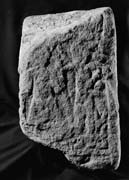
Object type: Shaft fragment [1]
Measurements: H. 46.3 cm (18.2 in) W. 27 cm (10.6 in) D. 20.6 cm (8.1 in)
Stone type: As no. 4
Plate numbers in printed volume: Ills. 420–2
Corpus volume reference: Vol 6 p. 144-145
(There may be more views or larger images available for this item. Click on the thumbnail image to view.)
A (broad) : The edge mouldings are damaged, though fairly broad. One end of a long panel survives with a box-point terminal and below it on the left a female figure in a long flared skirt, her arms raised from the elbows, but all features worn away. On the right is a male figure, with visible legs, facing the woman and grasping her raised wrist. His other arm is akimbo and he wears a sword that extends to the edge of the panel. In the right-hand corner is perhaps a fragment of twist and part of a transverse moulding.
B (narrow) : The edge mouldings are flat. A long panel contains a chain of elongated links with pellet fillers. The effect is almost of stopped-plait.
C (broad) : The flat edge mouldings turn to form a transverse moulding at the top. Within the panel is a bold and crudely cut twin-link (closed circuit pattern B), roughly hacked, with attenuated terminals. In the spandrels are triquetra fillers in narrower strand which are disorganised. Below the twin-link are linear strap elements which may be parts of a stylised dog whose knotted tail forms the filler. Above its back there may be a backward-looking canine head.
D (narrow) : Scabbled.
Collingwood did not illustrate face A, which must be the principal face. The closest parallel for the two figures is the re-worked cross-arm at Weston, near Otley, West Riding (Bailey 1981, 92, cat. F16, ills. on 61), though both carvings are enigmatic: rescue and aggression are both possibilities. The ornamental repertoire and style of cutting are different from most other carvings at the site.
Collingwood 1907, 275, 282, 286, 287, 351, figs. q–r on 350; Collingwood 1912, 125; Collingwood 1915, 263, 264
[2] Since J.L. wrote this, a second example of ring-chain has been discovered on Upleatham 5 (Ill. 834). (Eds.)
