Select a site alphabetically from the choices shown in the box below. Alternatively, browse sculptural examples using the Forward/Back buttons.
Chapters for this volume, along with copies of original in-text images, are available here.


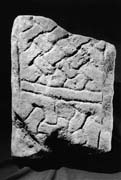
Object type: Shaft fragment [1]
Measurements: H. 39.7 cm (15.6 in) W. 26.3 cm (10.4 in) D. 19.8 cm (7.8 in)
Stone type: Coarse feldspathic gritstone with sub-rounded grains and prominent bedding planes parallel to the main face. Pale yellow (2.5Y 7/4). Again Millstone Grit, Namurian, Upper Carboniferous, from a Pennines source
Plate numbers in printed volume: Ills. 416–9
Corpus volume reference: Vol 6 p. 144
(There may be more views or larger images available for this item. Click on the thumbnail image to view.)
A (broad) : The edge mouldings are damaged. Of two panels, the upper has clumsy basket plait in flat strand, not gridded. Below it is a rough flat transverse moulding and below that the top of a ring-knot with return loops in flat strand.
B (narrow) : The edge mouldings are flat. The panel contains confused interlace in flat strand, one element of which is Y-shaped and might be a vertebral ring-chain motif. The element above is not as clearly defined as in Collingwood's drawing (1907, fig. p). It is not placed axially, being further to the right.
C (broad) : Worn away, apart from faint trace of edge moulding.
D (narrow) : The lower left-hand corner has a modelled edge moulding and faint traces of broad strand interlace.
The piece was carved free-hand and its layout is clumsy. However, the division of the face into small panels is typical of the site's sculpture, and if the vertebral ring-chain drawn by Collingwood is accepted it is the only example in the region.[2] It might be compared with the cross at Burnsall, West Riding (Collingwood 1915, 146–8, fig. e) rather than Cumbrian versions, and it would speak of Scandinavian taste.
