Select a site alphabetically from the choices shown in the box below. Alternatively, browse sculptural examples using the Forward/Back buttons.
Chapters for this volume, along with copies of original in-text images, are available here.


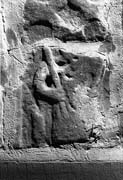
Object type: Cross-head fragment(?) [1] [2]
Measurements: H. 20.5 cm (8.1 in) W. 18.6 cm (7.3 in) D. Built in
Stone type: As no. 2
Plate numbers in printed volume: Ill. 427
Corpus volume reference: Vol 6 p. 149-150
(There may be more views or larger images available for this item. Click on the thumbnail image to view.)
On the left is a narrow modelled edge moulding, and set in from it a vertical bar. Broken at top and bottom, enough remains of a figure to identify the lower half of a pear-shaped face with a drilled mouth, and the right arm, held akimbo, with the hand holding a diagonal rod across the shoulder. The fingers of this hand and the other are delineated. The hand on the right holds a similar staff.
Possibly a shaft fragment or the neck of a cross, the image it carries is usually placed on the cross-head, in an Irish context. A typical Irish example is the cross at Durrow, Co. Offaly, where a similar un-nimbed Christ in Judgement holds a cross and a flowering sceptre diagonally across his shoulders (Harbison 1992, I, 79–80, II, fig. 248), and other examples abound in Ireland. The image occurs much earlier in the Insular world in the Luke/Christ portrait of the Lichfield Gospels (Nordenfalk 1977, 81, pl. 25), though that example is open to alternative exegesis (Henderson, G. 1987, 122–4). The origins of the Kirklevington piece are more likely sculptural, and since the image is not found in Anglian or Anglo-Scandinavian contexts, once again an Irish model presents itself. Its ultimate Near Eastern sources are more easily explained in terms of Irish monasticism which drew from early Christian traditions in Egypt, whence the 'Osiris-judge' pose may have come (Henry 1964, 47–8).
