Select a site alphabetically from the choices shown in the box below. Alternatively, browse sculptural examples using the Forward/Back buttons.
Chapters for this volume, along with copies of original in-text images, are available here.


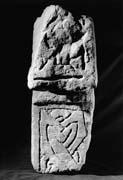
Object type: Cross-head fragment [1] [2]
Measurements: H. 40.3 cm (15.9 in) W. 36.5 cm (14.4 in) D. 16.5 cm (6.5 in)
Stone type: Medium-grained deltaic sandstone with prominent bedding places parallel to the front face. Brownish yellow to yellow (10YR 6/6–7/6); dark yellowish brown (10YR 3/6) limonite concentrations parallel to the cross edge. Stone provenance as no. 1
Plate numbers in printed volume: Ills. 442–5
Corpus volume reference: Vol 6 p. 148-149
(There may be more views or larger images available for this item. Click on the thumbnail image to view.)
Only the neck and the left-hand arm survive of a billet-head cross (Cramp 1991, fig. 3.4).
A (broad) : The edge moulding frames a type B11 cross, whose billets are recessed in circular arm-pits. The shaft is scabbled. The cross-head carries a Crucifixion with small, possibly naked legs and outward turned feet. One arm with a huge hand, all the fingers showing, fills the lateral limb.
B (narrow) : The cross-arm is broken away. The clumsy flat edge moulding survives on the right and across the top of the shaft. Within the shaft panel is a three-cord frond-like terminal; on the left the innermost strand has a volute tip. The right-hand one is damaged. Where they interlace, the left-hand one penetrates the strand of that on the right. The cutting is free-hand.
C (broad) : The two lower recessed billets survive. There is a broad flat edge moulding with a lip on the lower limb. The cross is plain within the moulding. In the shaft's panel are two upright confronting beasts, only their upper halves surviving. The left-hand animal has pricked ears and grinning jaws; the right-hand beast has beak-like jaws and a globular brow. Their forelegs meet, possibly cross. The cutting is crude.
D (narrow) : The arm-tip has the remains of a broad flat edge moulding. The panel possibly contained a ring-knot, now much defaced. The arm-tip has a lip and the surface of the billet is roughly dressed. The top edge moulding of the shaft stands proud above a transverse moulding. The shaft panel contains bungled interlace in a variety of single and median-incised strands.
The billet head is a fairly uncommon form, though there are Ryedale parallels in Middleton 3 (Lang 1991, 184–5, ill. 682–5) and Kirkdale 1 (ibid., 158–9, ill. 546). Akin to the plate head, its function is to stabilise the narrowest parts of the cross. There are many Irish examples which are more decorative: the Market Cross at Kells, Co. Meath, and its fellow the Cross of St Patrick and St Columba (Harbison 1992, II, figs. 337, 355), both the Tall Cross and Muiredach's Cross at Monasterboice, Co. Louth (ibid., figs. 481, 490), and the North and South Crosses at Castlekeeram, Co. Meath (ibid., figs. 112, 113). The standing beasts are very rough and worn, though in the light of Kirklevington 4 (Ill. 412) they may be reflexes of the iconography associated with the Temptation of St Antony. The Crucifixion is of the Irish type (see Chap. V, p. 37).
[1] The following are general references to the Kirklevington stones: Browne 1880–4, cx, cxii; Young 1882, 458; Allen and Browne 1885, 352; Frank 1888, 44; Bulmer 1890, 162; Hodges 1894, 195; (—) 1896–1905a, viii; Lofthouse 1896–8, 16; (—) 1899–1900b, 250; Morris, J. 1904, 228–9, 420; Collingwood 1908, 120; Page, W. 1923, 262; Morris, J. 1931, 229, 417; Elgee and Elgee 1933, 217, 248; Mee 1941, 136; Pevsner 1966, 221; Morris, C. 1976a, 143–4; Brown, M. 1979, 44; Horton 1979, 195; Bailey 1980, 252, 255, 265; Cramp 1984, 30; Lang 1991, 42, 214; Daniels 1995, 81; Stocker 2000, 200–3.
[2] The following is an unpublished manuscript reference to no. 16: BL Add. MS 37552 no. XIV, item 647 (Romilly Allen collection).
