Select a site alphabetically from the choices shown in the box below. Alternatively, browse sculptural examples using the Forward/Back buttons.
Chapters for this volume, along with copies of original in-text images, are available here.


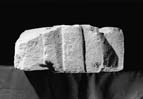
Object type: Grave-marker
Measurements: H. 54 cm (21.25 in) W. 33.8 cm (13.3 in) D. 12.5 cm (4.9 in)
Stone type: Medium-grained brownish yellow (10YR 6/6) sandstone, relatively well sorted with sub-rounded grains. Stone provenance probably as Lythe 2a–b (St Oswald)
Plate numbers in printed volume: Ills. 498–502
Corpus volume reference: Vol 6 p. 157
(There may be more views or larger images available for this item. Click on the thumbnail image to view.)
A (broad) : A type B8 cross-head stands in relief from a recessed rectangular solid head. The lateral arms are shaped to preserve the squared corners and the upper limb has a central crest rising from an inwardly inclined panel. At the intersection of the cross is a flat raised circular boss. The lower limb, after a shallow expansion, merges with the shaft which is straight-sided and plain.
B and D (narrow) : Plain.
C (broad) : As face A, but more damaged; the boss is lost.
E (top) : The ridge on the top of the upper limb stands proud.
A series of eight of these stumpy plain crosses is found at Lythe (nos. 9–16) and there are no parallels for them at other sites. There is no ornament which could suggest either their date or their milieu, although their association with type k (enriched shrine) hogbacks, which are also confined to Lythe and its district (Lang 1984a, 101), might well explain their function. The type k hogbacks (see nos. 17–24 below) have richly ornamented long sides but plain truncated ends. They also have steep straight roof pitches which often reflect the angle of the lower splayed limb of this series of cruciform grave-markers (cf. Ills. 512, 534). It is likely that these upright end-stones were placed up against the ends of the recumbent hogback; they might even have conveyed the impression of finial crosses (see Chap. VI, p. 49). Such a composite arrangement is confirmed by documentary evidence for the Inchcolm hogback on the east coast of Scotland (Lang 1972–4, 209–11) and by usage in the cemetery beneath York Minster (Lang 1991, 28). A comparison of Colling-wood's drawings f, g, h with dd, ee, ff (Collingwood 1911, 288, 294) demonstrates the close relationship with the hogbacks at Lythe. There is some variation of cross shape and bosses in the series.
