Select a site alphabetically from the choices shown in the box below. Alternatively, browse sculptural examples using the Forward/Back buttons.
Chapters for this volume, along with copies of original in-text images, are available here.


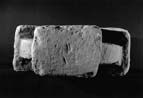
Object type: Cross-head
Measurements: H. 38 cm (15 in) W. 40.2 cm (15.8 in) D. 15.2 cm (6 in)
Stone type: Fine-grained, indifferently sorted, micaceous feldspathic sandstone with traces of bedding planes parallel to the main cross faces. Very pale brown (10YR 7/3). Deltaic sandstone of the Saltwick Formation, Aalenian, Middle Jurassic; stone probably obtained from quarries in the vicinity of Lythe Bank
Plate numbers in printed volume: Ills. 493–7
Corpus volume reference: Vol 6 p. 156-157
(There may be more views or larger images available for this item. Click on the thumbnail image to view.)
A (broad) : The cross is type B6 with splayed, wedge-shaped arms. The ring above the transverse axis is pierced, but below it takes plate-head form. The ring is recessed from the face of the cross and the arms extend beyond the circumference of the wheel. There is no decoration.
B and D (narrow) and E (top) : Plain.
C (broad) : As face A.
Collingwood thought this may even have been post-Conquest, though 'pre-Norman' in form. Certainly twelfth-century wheel-heads exist, including plate-head forms at Whitby Abbey nearby (Ills. 1168–71, 1176–9). It may be compared with Sockburn 12, co. Durham (Cramp 1984, 140, pl. 140, 749–50), and this stone must share the guarded commentary given to it.
