Select a site alphabetically from the choices shown in the box below. Alternatively, browse sculptural examples using the Forward/Back buttons.
Chapters for this volume, along with copies of original in-text images, are available here.


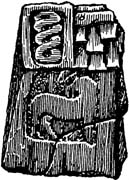
Object type: Hogback fragment
Measurements: L. 27.9 cm (11 in) W. 31.7 cm (12.5 in) H. 40.6 cm (16 in)
Stone type: As Lythe 9 (St Oswald)
Plate numbers in printed volume: Ills. 532–5
Corpus volume reference: Vol 6 p. 160
(There may be more views or larger images available for this item. Click on the thumbnail image to view.)
There are the remains of a defaced ridge.
A (long) : Below the ridge are three rows of type 2c tegulae on a steep pitch, flanked by an end panel framed with a plain moulding, containing closed circuit interlace in modelled strand: a run of four-cord plait. Below the eaves on the vertical side is a profile bird, its tail and wing spread and its claw a large talon. It faces inwards and its panel mouldings are worn away.
B (end) : Truncated and plain with a gabled profile.
C (long) : Tegulation is as on face A. The end panel is worn but carries traces of a run of two-cord twist. On the vertical side below is a recessed rectangular panel containing a profile quadruped (its forelegs are now lost, though shown in Collingwood's drawing), whose head is turned backwards to touch its back. It has short horns; its mouth is an incised slit.
A type k hogback; see Lythe 17 (St Oswald). The quadruped is identical with that on the shaft Lythe 1 (Ill. 463), possibly from the same template. It is even possible that Lythe 1 served as an end-stone to the plain gable of this hogback, making a composite monument (Chap. VI, p. 49).
