Select a site alphabetically from the choices shown in the box below. Alternatively, browse sculptural examples using the Forward/Back buttons.
Chapters for this volume, along with copies of original in-text images, are available here.


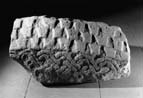
Object type: Hogback fragment
Measurements: L. 68.6 cm (27 in) W. 33.7 > 29.2 cm (13.2 > 11.5 in) H. 35.6 > 27.9 cm (14 > 11 in)
Stone type: As Lythe 9 (St Oswald)
Plate numbers in printed volume: Ills. 544–5
Corpus volume reference: Vol 6 p. 161
(There may be more views or larger images available for this item. Click on the thumbnail image to view.)
There is a defaced ridge on a pronouncedly curved top.
A (long) : Below are three rows of type 2b tegulae. Beneath the eaves on the vertical side are the upper loops of a horizontal run of interlace in median-incised strand; seven stages survive, though the lower part and ends are lost.
C (long) : There are three rows of tegulae as on face A. The vertical side is damaged and covered with mortar, but shows the remains of a figural scene in low relief.
The head and torso of a frontal naked figure with arms raised is flanked by two serpentine creatures.[1]
A type k hogback; see Lythe 17. The figure on face C, only visible in strong cross-lighting, has a wedge-shaped face of typically Viking-age type and indeed the iconography of this scene seems to be based on Scandinavian mythology, in which figures struggle with serpents. Lythe seems to be a particularly important Viking-age burial ground, and this scene can be found on hogbacks and crosses in Cumbria: at Gosforth a hogback (no. 5) shows a small human figure struggling in the coils of a serpent, which is a close parallel (Bailey and Cramp 1988, 107, ills. 323, 327), and on two hogbacks from Lowther (nos. 4 and 5), figures which seem more clearly female are similarly enmeshed (ibid., 130, ills. 444–50). At the base of the cross at Great Clifton, also in Cumbria, is a similar forward-facing figure surrounded by serpents (ibid., 110–11, ill. 335). The popularity of such scenes may have been because they could be used in a conversion situation to interpret a Scandinavian legend in Christian terms. A similar motif is the juxtaposition of Týr putting his hand into the mouth of the wolf Fenrir, and Daniel in the lions' den, as found on Sockburn 21 (Cramp 1984, 143–4, pl. 146, 767–8). Indeed, since this scene at Lythe is truncated at the base, and the upraised arms of the figure do seem prominent and could be in the orans position, then this also could be a Daniel scene in which he is pushing apart two fanged creatures whose bodies are more serpentine than leonine. In which case this is an illustration of the power of good triumphing over the forces of evil, which are depicted in the Scandinavian rather than the early Christian form.
