Select a site alphabetically from the choices shown in the box below. Alternatively, browse sculptural examples using the Forward/Back buttons.
Chapters for this volume, along with copies of original in-text images, are available here.


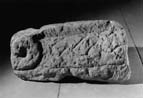
Object type: Hogback fragment
Measurements: L. 52.7 cm (20.75 in) W. 21.6 cm (8.5 in) H. 25.4 cm (10 in)
Stone type: As Lythe 26 (St Oswald), but this fragment is not burnt.
Plate numbers in printed volume: Ills. 565–8
Corpus volume reference: Vol 6 p. 164
(There may be more views or larger images available for this item. Click on the thumbnail image to view.)
A (long) : The top of the ridge carries step fret (type 1) between plain mouldings. Its sides are damaged but diagonal marks may once have been bold cable. Below it the steeply pitched roof is covered with interlace in broad flat strand, picked; it is closely woven three-cord plait with an uncertain termination. A broad plain moulding lies below.
Only the sides of the end-beast survive. On each face is a volute resembling a ram's horn in relief.
B and D (ends) : Broken.
C (long) : As face A, but the lower part is damaged. The iron fragment recorded by Collingwood has disappeared.
The end-beast is odd, and because of damage difficult to interpret. Collingwood'speculated that a small hole on one side might be a serpent's eye. However, the shape of the scar on top of the stone suggests a jowl.
