Select a site alphabetically from the choices shown in the box below. Alternatively, browse sculptural examples using the Forward/Back buttons.
Chapters for this volume, along with copies of original in-text images, are available here.


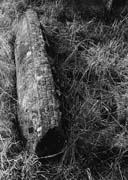
Object type: Hogback
Measurements: L. 113 cm (44.5 in) W. 20.3 > 17.8 cm (8 > 7 in) H. 40.6 < 44.4 > 38.1 cm (16 < 17.5 > 15 in)
Stone type: As Lythe 1 (St Oswald)
Plate numbers in printed volume: Ills. 572–4
Corpus volume reference: Vol 6 p. 164
(There may be more views or larger images available for this item. Click on the thumbnail image to view.)
The ridge has step 1 fret between plain mouldings on its top.
A (long) : Very worn, but there are traces of interlace in low relief, perhaps median-incised. The pattern consists of a single element, twisted near each end and once in the centre. At each end of the long interior panels formed by the twist is a ring.
B and D (ends) : Broken. The prominent ridge and narrow section creates a trefoil profile.
C (long) : There are the remains of interlace in the same flat strand as face A. Scrolls and twists flank the principle intersection of a loosely ordered circuit.
This hogback differs from most of the other Lythe examples which are either dragonesque or shrine types. It is higher and its ridge is distinctive in section. What remains of its ornament is conventionally Anglo-Scandinavian, with twists and free rings to convey the illusion of interlace. There is some resemblance to Brompton 26 (Ills. 107–8), but there the decoration is zoomorphic.
