Select a site alphabetically from the choices shown in the box below. Alternatively, browse sculptural examples using the Forward/Back buttons.
Chapters for this volume, along with copies of original in-text images, are available here.


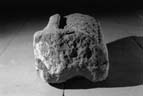
Object type: Hogback fragment
Measurements: L. 46.4 cm (18.25 in) W. 25.4 cm (10 in) H. 22.2 > 21.6 cm (8.75 > 8.5 in)
Stone type: As Lythe 15 (St Oswald)
Plate numbers in printed volume: Ills. 569–71
Corpus volume reference: Vol 6 p. 164-165
(There may be more views or larger images available for this item. Click on the thumbnail image to view.)
The ridge tapers and has traces of fret pattern.
A (long) : On the rounded flattish roof pitch is closed circuit interlace in a broad median-incised strand, picked. There are pellet fillers in the spandrels. The interlace is clumsily resolved, though it attempts a four-cord plait. Below this the vertical side is 15.2 cm high and roughly hacked.
B (end) : Lost.
C (long) : As face A, but broken away.
D (end) : In place of an end-beast there is a 'wheel rim' set at right-angles to the ridge and raised from the tapering roof pitch. The rim carries step 1 fret between plain mouldings. The end is damaged.
In northern England type j hogbacks, the wheel rim, are extremely rare: confined to Lythe 30 and 31. It may not be a local idiosyncrasy, for there are similarities with a kindred monument at Shelton, Nottinghamshire (Lang 1984a, 172), and a recently established group in the Trent Valley area (Everson and Stocker 1999, 35–6, fig. 22). The low sides of this monument are of the same dimensions as those of its companion, Lythe 31, but slightly differing stone types have been used.
