Select a site alphabetically from the choices shown in the box below. Alternatively, browse sculptural examples using the Forward/Back buttons.
Chapters for this volume, along with copies of original in-text images, are available here.


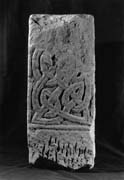
Object type: Door jamb
Measurements: H. 65.5 cm (25.8 in) W. 27 cm (10.6 in) D. 14.8 cm (5.8 in)
Stone type: As Lythe 7 (St Oswald), however this stone is slightly micaceous.
Plate numbers in printed volume: Ills. 593–6
Corpus volume reference: Vol 6 p. 167
(There may be more views or larger images available for this item. Click on the thumbnail image to view.)
A (broad) : There is no taper. The edge moulding is rolled and fairly narrow. A single panel is filled with the remains of two units of complete pattern A interlace, median incised, with cross-joined terminals below. The cutting is shallow. Beneath the panel is a plain area with rough vertical tooling in the lower part.
B–D: The back and sides have been dressed, probably in antiquity
Collingwood considered the possibility of this being a jamb from a pre-Conquest church, and its lack of taper and single carved face would support that view. Now that the finial, Lythe 37, has been identified as an architectural fragment, there are two relics from an early church, a building certainly earlier than the eleventh-century one postulated by Colling-wood (1911, 289). Such a church may well have been a cell of Whitby's monastery: see below.
