Select a site alphabetically from the choices shown in the box below. Alternatively, browse sculptural examples using the Forward/Back buttons.
Chapters for this volume, along with copies of original in-text images, are available here.


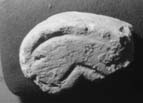
Object type: Finial
Measurements: L. 20.8 cm (8.2 in) W. (at volute) 13.5 cm (5.3 in); (at neck) 9.5 cm (3.7 in) D. 9.5 cm (3.7 in)
Stone type: [Buff sandstone]
Plate numbers in printed volume: Ill. 586
Corpus volume reference: Vol 6 p. 167
(There may be more views or larger images available for this item. Click on the thumbnail image to view.)
A gable finial, broken at its stem.
A (broad) : The finial curves into a smooth volute in a flat plane. The plain edge moulding is 2.0 cm wide and follows the contour of the edge all round.
B and D (narrow) : Plain.
C (broad) : Identical with face A.
Such gable finials, common in Ireland (Leask 1955, 46–7, fig. 20; Harbison 1970, 54–7, figs. 18–20) have recently been recognised in Northumbria at Heysham, Lancashire (Andrews 1978, 2)[1] and Lastingham in Ryedale (Lang 1991, 171–2, no. 9). This example is plainer than those but well cut and dressed. It is an architectural appendage that might be found on a seventh-century or early eighth-century church, such as the one documented at Lastingham (Bede 1969, 288, iii.23). Most of the monuments at Lythe represent a Viking-age cemetery, but this finial, together with the door jamb, no. 36, suggests a pre-Anglo-Scandinavian church. Lythe is visible on its headland from the next promontory, Whitby. It is possible that, separated only by Whitby Strand, Lythe was a cell of the Whitby estate (Cambridge 1995b, 140–3) at the time when the monastery was under the strong influence of the Irish church through Lindisfarne. The smoothly dressed surface, possibly rubbed with an abrasive stone, the absence of incised or relief ornament, and the neat edge moulding put the finial's treatment very close indeed to the series of early crosses from the abbey site at Whitby (see Chapter VI).
Nos. 36 and 37 from Lythe demonstrate that the other, funerary stones from the Anglo-Scandinavian period were placed within a long established ecclesiastical site; such early churches either continued in use through the tenth century or their plots served as Christian graveyards, as at Lastingham. Oddly, there is a paucity of Anglo-Scandinavian pieces from Whitby itself.
