Select a site alphabetically from the choices shown in the box below. Alternatively, browse sculptural examples using the Forward/Back buttons.
Chapters for this volume, along with copies of original in-text images, are available here.


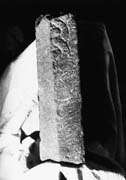
Object type: Shaft fragment [1]
Measurements: H. 57 cm (22.4 in) W. 29.5 > 22.2 cm (11.6 > 8.8 in) D. 14 cm (5.5 in) [2]
Stone type: Unobtainable
Plate numbers in printed volume: Ills. 645–8
Corpus volume reference: Vol 6 p. 172
(There may be more views or larger images available for this item. Click on the thumbnail image to view.)
A (broad) : An irregular flat edge moulding exists on the right, turning as a hacked plinth across the base. The left-hand edge did not have an edge moulding. The face is occupied by three half-coiled snakes surmounted by random clusters of pellets. The arrow-heads of the serpents converge on a frontally disposed human figure who stands in the lower right-hand corner. His knees are slightly bent and his arms are raised in the orans position with clenched fists. His oval head has primitive features: from drilled eyes a U-shaped incision depicts the nose. A narrow beard descends from the chin. His very short kirtle reveals the figure to be phallic.
B (narrow) : Within a plain border is part of a closed circuit pattern of three-cord plait, with pellets filling the ground between and the unpinned loop below. The broad flat strands are irregularly cut.
C (broad) : There is a rudimentary undulating edge on the left. The right-hand edge has been dressed off. The face is filled by a human figure almost identical with that on face A. Three half-coiled snakes attack him and clusters of irregular pellets serve as fillers.
D (narrow) : Dressed off and chamfered, but with traces of interlace at the top probably identical to face B.
This piece belongs to the Lower Wensleydale workshop (Chap. VI, pp. 49–50), and the rough carving and trick of incising facial features are indications of that group. Compare with Coverham 1 (Ill. 125) and Thornton Steward 2 (Ills. 793–6).
[1] The following is an unpublished manuscript reference to no. 3: BL Add. MS 37552 no. XIV, item 683 (Romilly Allen collection).
[2] The measurements were kindly provided by Dr Elizabeth Coatsworth. (Eds.)
