Select a site alphabetically from the choices shown in the box below. Alternatively, browse sculptural examples using the Forward/Back buttons.
Chapters for this volume, along with copies of original in-text images, are available here.


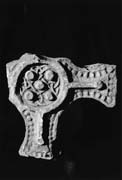
Object type: Part of cross-head [1] [2]
Measurements: H. 41 cm (16.1 in) W. 42 > 17 cm (16.5 > 6.7 in) D. 14 > 13 cm (5.5 > 5.1 in)
Stone type: As Northallerton 1 (All Saints). This could be part of the same cross.
Plate numbers in printed volume: Ills. 672–6
Corpus volume reference: Vol 6 p. 182-183
(There may be more views or larger images available for this item. Click on the thumbnail image to view.)
A (broad) : A free-armed cross of type B9 with wide curving arm-pits and wedge-shaped limbs. The edge moulding is well modelled and within it is a moulding of pellets. Within these, in relief from the plain background, is a 'spine-and-boss' cruciform moulding, which has a dominant ring in the centre of the cross-head, linking the pellet strips in the arms. Within the roundel are five symmetrically placed small bosses, their domed tops scraped flat. Between the bosses, a filiform narrow strand forms another cross with pattern E (Stafford knot) terminals and embracing the central boss.
B (narrow) : The arm-tip has a modelled edge moulding. Within it is a pair of pattern D loops whose strands not only extend to form bar terminals above and below but also an inner moulding integral with the interlace. Within the curve of the arm-pit, inside narrow edge mouldings is a series of horizontal incised lines surmounted by a saltire within a square.
C (broad) : As face A, except for the pellet moulding. In its place is a deeply cut zig-zag run.
D (narrow) : The cross-arm is lost. On the lower arm-pit, between narrow edge mouldings, is a series of horizontal and vertical strips within rectangular frames, all in narrow modelled strand.
E (top) : The cross-arm is lost. On the surface of the arm-pit, between modelled edge mouldings, is part of a spiral scroll with a double fleshy stem. One scroll has a pair of terminal leaves, veined and of half-moon shape. Single pellets fill the spandrels.
F (bottom) : There is a mortise hole, 3.5 cm wide and 2.5 cm deep, slightly off-centre in the base of the lower arm.
This is a finely carved early Anglian piece, with parallels beyond north Yorkshire in Jarrow 8 and 9 (Cramp 1984, 109, pl. 93, 497–500), Carlisle 3 (Bailey and Cramp 1988, 86–7, ill. 210), Hexham (Cambridge 1995a, 108–9, fig. 33; see Ill. 1192) and Heysham (Collingwood 1927a, 95, fig. 128). The Jarrow analogue also has the restrained patterns of the arm-pits, which have been related to baluster designs by Cramp. The zig-zag also occurs on the altar pillar (Cramp 1974, 136, pl. XXIII, a, b) and the cross-head at Ripon (Collingwood 1915, 233–4, figs. a–c). So far flung are the parallels that it is unwise to focus on a particular source, like Ripon, for this group. It is safer to rely upon Rosemary Cramp's judgement: 'it seems indeed as though in the period of the greatest artistic activity of the monasteries – the eighth century – there were common fashions and regular exchanges of models' (1974, 136).
It is very clear that the ornament of this cross had close relationships with contemporary metalwork, and Collingwood was the first to see the similarities with the base of the Ormside bowl (Collingwood 1907, 372; Webster and Backhouse 1991, 172–3, no. 134), particularly the five stud-bosses laced by cruciform interlace, and even the panel divisions with their echoes of a spine-and-boss cross (see Ill. 1196, and Chap. VI, pp. 43–4). The inner perimeter moulding of pellets might also be compared with St Cuthbert's pectoral cross, whose shape is similar to that of no. 5 (Webster and Backhouse 1991, 133–4, no. 98). The late eighth-century dating of the Ormside bowl (ibid., 173) accords with that of the spiral scroll of the cross-arm edges. It is likely, but not proven, that the shaft fragment, no. 1, belongs to this cross; they share the zig-zag motif (Chap. VI, pp. 40–1) and the same stone type.
[1] The following are general references to the Northallerton stones: Browne 1880–4, cx, cxi; Allen and Browne 1885, 352; Saywell 1885, 5, 6, 218, 219, 222; Saywell 1886, 480–1; Bulmer 1890, 525, 526; Robinson, J. 1890, 35, fig. 9; Hodges 1894, 195; Morris, J. 1904, 280, 420; Bogg 1908, 14; Collingwood 1912, 110, pl. III; Page, W. 1914, 426, 429; Morris, J. 1931, 280, 417; Elgee and Elgee 1933, 195, 249; Mee 1941, 169; Pevsner 1966, 271; Bailey 1980, 240, 252, 255; Cambridge 1989, 382, 384, 385; Morris, R. 1989, 138; Hadley 2000, 244; Stocker 2000, 205–6. The following is an unpublished manuscript reference to the Northallerton stones: BL Add. MS 37552 no. XIV, item 702 (Romilly Allen collection).
[2]The following is an unpublished manuscript reference to no. 5: BL Add. MS 37552 no. XIV, item 704 (Romilly Allen collection).
