Select a site alphabetically from the choices shown in the box below. Alternatively, browse sculptural examples using the Forward/Back buttons.
Chapters for this volume, along with copies of original in-text images, are available here.


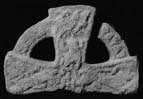
Object type: Part of cross-head
Measurements: H. 37 cm (15.6 in) W. 55.5 cm (21.85 in) D. 11.5 cm (4.52 in)
Stone type: Very coarse-grained feldspathic Millstone Grit with very angular grains. Mainly very pale brown (10YR 8/3) with ferruginous patches, yellow coloured (10YR 7/3). Probably the Red Scar Grit, Namurian, Upper Carboniferous, from the Ure valley to the west of the site
Plate numbers in printed volume: Ills. 726–9
Corpus volume reference: Vol 6 p. 192
(There may be more views or larger images available for this item. Click on the thumbnail image to view.)
The cross is of type E6, with V-shaped arm-pits and curved tips to the arms. The ring is recessed from the arm tips by 1 inch (2.5 cm) and from the plane of the cross by rather less.
A (broad) : The face of the ring has a narrow plain moulding on both the inner and outer edges, flanking raised triangular elements that appear as a chevron strip. The cross-arms have a continuous flat plain edge moulding (1.7 cm wide). In each arm is a single profile animal, with no double outline but in other respects in the Jellinge style. Their hind legs and tails are interlocked in the centre of the cross. The animals are disposed in a running position, facing out from the centre. Each has an extended ear-lappet and a single fetter crossing the body. Each has a short snout and an incised eye.
B and D (narrow) : Within a narrow plain edge moulding are the remains of a four-cord plait in narrow strand.
C (broad) : Very worn. Remains of the narrow edge moulding survive.
E (top) : The upper arm-tip is plain.
The ring-head form is very typical of cross-heads in the North Riding. It is ultimately of Irish origin (Lang 1991, 30) and indicates a Norse-Irish milieu in this northern part of the county. The chevron decoration of the ring is like some in Ryedale, notably Kirkbymoorside 5 (Lang 1991, 157, ills. 531–5) and Middleton 2 (ibid., 182–4, ills. 676, 678), though the form of the ring is less distinctive than these parallels. The Jellinge-style beast, which bears comparison with that of the hogback Pickhill 4 (Ill. 737), is ingeniously disposed on the cross-head but remains coherent, more like the Clifford Street 1 slab in York (ibid., 102–3, ill. 331). The proportions of the animal are substantial and the fettering relatively free. It is an original use of the Jellinge beast, which for once is not linear.
