Select a site alphabetically from the choices shown in the box below. Alternatively, browse sculptural examples using the Forward/Back buttons.
Chapters for this volume, along with copies of original in-text images, are available here.


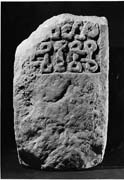
Object type: Lower part of shaft [1]
Measurements: H. 54.5 cm (21.5 in) W. 32.5 cm (12.8 in) D. 15.2 cm (6 in)
Stone type: Fine-grained micaceous deltaic sandstone with sub-angular grains. Light yellowish brown (10YR 6/4) with limonite flecks (yellowish brown, 10YR 5/6). Coal Measure (Westphalian, Upper Carboniferous) sandstone, which has been imported into the region, probably via the Roman fort at Aldborough.
Plate numbers in printed volume: Ills. 730–3
Corpus volume reference: Vol 6 p. 192-193
(There may be more views or larger images available for this item. Click on the thumbnail image to view.)
A (broad) : Plain edge mouldings rise from an undecorated plinth. The base of a panel retains a small Latin cross with straight-sided limbs, wedge shaped (type B8). This is flanked by a pair of rectangular twists with loops on the corners. Half of the left-hand motif is lost. Above this are the terminal loops of what might have been adjacent runs of Como-braid, or S-twist. The cutting is deep and the hole-points drilled.
B (narrow) : Within a plain edge moulding is irregular median-incised interlace, terminating in an unpinned loop flanked by loose strands or tendrils. The base of the panel is stepped and the lower part is plain.[2]
C (broad) : Plain edge mouldings rise from an undecorated plinth. Within the panel the carving is damaged, but possibly shows a horse and rider in profile.
D (narrow) : Traces of defaced interlace above the plinth.
The twist patterns are popular in Allertonshire and the plastic carving indicates some competence. The cross is an unusual feature to find in this position, and its resemblance to the series at Lythe, nos. 9–16 (Ills. 499–531), is probably fortuitous.
